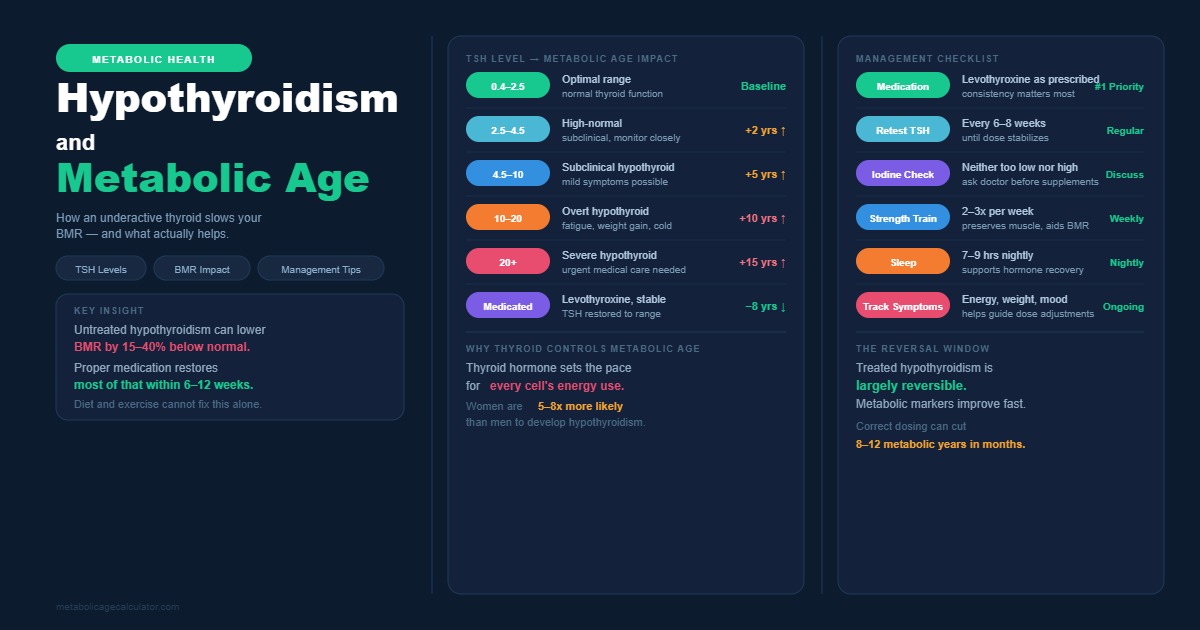
Hypothyroidism metabolism slows because low thyroid hormone reduces your basal metabolic rate (BMR) by up to 15%. Your body burns fewer calories at rest, stores more fat, and holds onto extra water weight. Millions of adults in the United States, United Kingdom, and Canada live with this condition, often without a clear diagnosis. Doctors frequently miss early hypothyroidism because fatigue and weight gain get blamed on stress or diet alone. Roughly 1 in 8 women develop a thyroid disorder during her lifetime, making this connection worth understanding closely. This guide explains exactly how hypothyroidism changes your metabolism and what specific steps restore it in 2026.
What Does Hypothyroidism Metabolism Slowdown Actually Mean?
Hypothyroidism metabolism slowdown means your thyroid gland produces too little thyroid hormone to run your cells at a normal pace. Your basal metabolic rate can drop by 10% to 15% once hormone levels fall below normal range. Thyroid hormone controls how fast your cells convert food into usable energy. Two hormones drive this process: triiodothyronine (T3) and thyroxine (T4). When your thyroid produces less of both hormones, every organ slows its energy output. Your heart rate drops, your body temperature falls, and your digestion slows down. You burn fewer calories completing the exact same daily tasks as before. This decline happens gradually, so many people mistake it for normal aging or reduced activity levels. Left unaddressed, this slowdown compounds over years and reshapes your entire daily energy budget.
How Much Does an Underactive Thyroid Lower Your BMR?
An underactive thyroid lowers your BMR by roughly 10% to 15% in moderate to severe cases. Mild or subclinical hypothyroidism produces a smaller drop, often 3% to 5% below your normal baseline. Your exact percentage depends on your TSH level, your age, and how long the condition goes untreated. This hypothyroidism metabolism impact varies by severity and by how quickly you start treatment. Two people with identical TSH readings can show different BMR drops based on muscle mass and baseline activity level.
Basal Metabolic Rate vs Resting Metabolic Rate in Hypothyroidism
Basal metabolic rate (BMR) measures the calories you burn at complete rest, without any digestion occurring. Resting metabolic rate (RMR) includes light digestion and runs 5% to 10% higher than BMR. Hypothyroidism lowers both numbers because thyroid hormone drives cellular respiration in every organ, including your liver, kidneys, and heart. You can track your own BMR and RMR shifts with a metabolic age calculator and compare results every 3 months. Consistent tracking under the same conditions, such as the same time of day and hydration level, produces the most reliable comparison over time.
Why Weight Gain Happens Even Without Overeating
Weight gain in hypothyroidism happens through 3 separate mechanisms: reduced calorie burn, water retention, and lower physical activity. Salt and water retention alone can add 5 to 10 pounds (2.3 to 4.5 kg) of body weight. Reduced BMR adds another layer, since your body needs 100 to 200 fewer calories daily than before. Fatigue from hypothyroidism cuts your daily movement, which lowers your total energy expenditure further. These 3 factors combine, so your scale weight rises even when your food intake stays identical. Many patients report gaining weight over 6 to 12 months before any thyroid symptom prompts a doctor visit.
What Causes Hypothyroidism-Related Metabolic Slowdown?
Hashimoto's disease causes roughly 90% of hypothyroidism cases across the United States, United Kingdom, and Canada. Your immune system attacks healthy thyroid tissue, which reduces hormone output over months or years. Iodine deficiency, thyroid surgery, and radiation treatment cause most remaining cases. Certain medications, including lithium and amiodarone, also block normal thyroid hormone production. Chronic stress raises cortisol, which can further suppress thyroid hormone conversion inside your cells. Managing cortisol and metabolism together often speeds up recovery for patients dealing with both issues. Genetics also play a measurable role, since children of parents with autoimmune thyroid disease face 3 times higher risk.
Hashimoto's Disease and Autoimmune Thyroid Damage
Hashimoto's disease develops when your immune system produces antibodies against thyroid peroxidase (TPO). These antibodies damage thyroid cells and reduce hormone output gradually over time. Women develop Hashimoto's disease 7 times more often than men, per American Thyroid Association data. A blood test measuring TPO antibodies confirms this diagnosis alongside standard thyroid panels. Family history raises your personal risk significantly, so relatives of diagnosed patients should request screening earlier.
Iodine Deficiency and Thyroid Hormone Production
Iodine deficiency limits your thyroid's ability to produce T3 and T4 hormones correctly. Your thyroid needs 150 micrograms of iodine daily to function within a normal range. Pregnant women need 220 micrograms daily to support fetal thyroid development properly. Iodized salt, seaweed, and dairy products supply reliable iodine in most Western diets. Strict diets that exclude iodized salt and seafood entirely raise deficiency risk over time.
Medications and Other Medical Triggers
Lithium, used for bipolar disorder, blocks thyroid hormone release from the gland directly. Amiodarone, a heart rhythm medication, contains high iodine content that disrupts thyroid function in some patients. Interferon treatments and certain cancer therapies can trigger thyroid inflammation as a side effect. Tell every prescribing doctor about your thyroid history so they can monitor these interactions closely.
Postpartum thyroiditis affects up to 10% of women within 12 months of delivery. This condition causes a hypothyroid phase after an initial period of overactivity, mirroring broader postpartum metabolic recovery shifts that affect new mothers.
What Are the Early Signs Your Metabolism Is Affected by Thyroid Function?
Nine signs point toward hypothyroidism-driven metabolic slowdown:
- Fatigue that persists after 8 hours of sleep
- Weight gain of 5 to 10 pounds (2.3 to 4.5 kg) without diet changes
- Cold intolerance in rooms other people find comfortable
- Dry skin and brittle, thinning hair
- Constipation lasting more than 3 days
- Muscle weakness during normal daily tasks
- Brain fog affecting memory and focus
- Slow heart rate below 60 beats per minute
- Puffiness around the eyes and face
These 9 signs develop slowly, often across 6 to 12 months. A blood test remains the only reliable way to confirm hypothyroidism as the cause. Many patients experience only 2 or 3 of these signs at first, which delays recognition further.
How to Diagnose Hypothyroidism Before It Damages Your Metabolism
To diagnose hypothyroidism before it damages your metabolism, request a thyroid-stimulating hormone (TSH) blood test from your doctor. A TSH level above 4.5 mIU/L signals an underactive thyroid in most laboratory reference ranges. Your doctor will also test free T4 and, in some cases, TPO antibodies. Subclinical hypothyroidism shows a raised TSH with normal T4, meaning your metabolism may already be slowing. Request testing every 12 months if you have a family history of thyroid disease. Bring a symptom log to your appointment, listing weight changes, energy levels, and sleep quality over the past 3 months. Early diagnosis prevents the deeper metabolic damage that untreated hypothyroidism causes over years.
Why Standard Blood Tests Sometimes Miss Early Hypothyroidism
Standard TSH testing alone misses cases where pituitary function, not thyroid function, drives the imbalance. Central hypothyroidism, caused by pituitary or hypothalamus problems, produces normal or low TSH alongside low T4. This rare pattern affects fewer than 1 in 20,000 people but confuses standard screening panels. Ask your doctor for a free T4 test alongside TSH if your symptoms persist despite normal TSH results. Lab reference ranges also vary between facilities, so compare your results against the same lab over time rather than switching between providers.
What Health Risks Come From an Untreated Hypothyroidism Metabolism Slowdown?
Untreated hypothyroidism raises LDL cholesterol by 10% to 20% within the first year of hormone deficiency. This elevated cholesterol increases your risk of heart disease and stroke over time. Slowed digestion from hypothyroidism also raises your risk of gallstones and chronic constipation. Severe, long-term cases can progress to myxedema, a rare but serious complication involving organ swelling and dangerously low body temperature. Regular monitoring through blood tests catches these risks long before they become emergencies. Untreated hypothyroidism during pregnancy also raises the risk of miscarriage and developmental delays in the infant. Treating your thyroid hormone deficiency early protects your heart, digestion, fertility, and long-term metabolic health together.
How to Restore Your Metabolism After a Hypothyroidism Diagnosis
To restore your metabolism after a hypothyroidism diagnosis, start levothyroxine treatment exactly as your doctor prescribes. Restoring hypothyroidism metabolism function starts with consistent medication adherence. Levothyroxine replaces missing thyroid hormone and returns your BMR toward normal within 6 to 8 weeks. Your doctor will recheck your TSH level 6 weeks after starting treatment or changing your dose. Correct dosing restores your energy levels before it fully restores any lost weight.
Levothyroxine Dosing and Metabolic Recovery Timelines
Levothyroxine dosing starts at 1.6 micrograms per kilogram of body weight for most adults. Your doctor adjusts your dose every 6 to 8 weeks based on TSH blood test results. Full metabolic recovery takes 3 to 6 months once your TSH reaches a stable, normal range. Skipping doses or taking levothyroxine alongside calcium and iron supplements blocks proper absorption. Take your dose on an empty stomach, 30 to 60 minutes before breakfast, for the most consistent absorption. Store your tablets away from heat and humidity, since both degrade the medication and reduce its effectiveness over time.
Exercise Choices That Support a Slow Thyroid
Strength training builds muscle mass, which raises your resting calorie burn more than cardio training alone. Aim for 2 to 3 strength sessions weekly, targeting major muscle groups like legs, back, and chest. Walking 7,000 to 10,000 steps daily supports calorie burn without overtaxing a slowed system. Avoid extreme calorie restriction, since starvation-level diets lower thyroid hormone conversion further. Untreated hypothyroidism accelerates muscle mass loss, which further slows your resting calorie burn over time. Low-impact activities, including swimming and cycling, suit patients dealing with joint pain or severe fatigue during early treatment. Increase training intensity gradually over 8 to 12 weeks rather than starting at full effort, since your energy reserves rebuild slowly.
Quick Reference: Hypothyroidism Metabolism Recovery Checklist
|
Task |
Timing |
Method |
Difficulty |
|
Get a TSH blood test |
Day 1 |
Lab blood draw |
Easy |
|
Start levothyroxine |
Day 1 to 7 |
Daily oral tablet |
Easy |
|
Recheck TSH level |
Week 6 |
Follow-up blood test |
Easy |
|
Add strength training |
Week 2 onward |
2 to 3 sessions weekly |
Moderate |
|
Track BMR changes |
Monthly |
Metabolic age calculator |
Easy |
|
Adjust levothyroxine dose |
Week 6 to 12 |
Doctor-guided titration |
Moderate |
What Foods Help or Hurt Thyroid-Related Metabolism?
Selenium and zinc support T3 conversion, so include Brazil nuts, oysters, and eggs regularly. Cruciferous vegetables, including raw kale, broccoli, and cabbage, can reduce iodine absorption in large raw quantities. Cooking these vegetables removes most of this effect, so steamed or roasted servings stay safe. Processed foods high in sodium worsen the water retention hypothyroidism already causes. Protein intake of 0.7 to 1 gram per pound (1.5 to 2.2 grams per kg) of body weight preserves muscle mass during recovery. Fiber-rich foods, including oats, lentils, and berries, ease the constipation that slowed digestion often causes. Drink 2 to 3 liters (68 to 101 fl oz) of water daily to support digestion and reduce bloating. Limit alcohol intake, since heavy drinking interferes with levothyroxine absorption and worsens fatigue symptoms.
How Does Hypothyroidism Metabolism Compare to Menopause and Aging?
Hypothyroidism metabolism slowdown differs from menopause and normal aging in speed and reversibility. Menopause lowers BMR by 2% to 3% per decade through gradual estrogen decline. Normal aging reduces BMR by roughly 1% to 2% per decade after age 20, mainly from muscle loss. Hypothyroidism can drop BMR by 10% to 15% within months, a faster and steeper decline. Treating hypothyroidism reverses most of the loss, while age-related decline requires ongoing strength training instead. Overlapping conditions, including menopause and hypothyroidism together, compound metabolic slowdown beyond either condition alone. Women over 40 should request thyroid testing alongside standard menopause bloodwork, since symptoms overlap significantly. Sleep deprivation causes a third type of metabolic slowdown, typically 2% to 5%, through elevated cortisol and disrupted hunger hormones. Identifying which condition, or combination of conditions, drives your specific slowdown determines which treatment actually works.
Frequently Asked Questions About Hypothyroidism Metabolism
Does hypothyroidism definitely cause weight gain?
Yes. Hypothyroidism causes weight gain in most patients, typically 5 to 10 pounds (2.3 to 4.5 kg), mainly from water retention and lower calorie burn rather than pure fat gain.
Can you fix your metabolism without medication?
No. Levothyroxine remains the only proven treatment that restores thyroid hormone levels and normal metabolic rate. Diet and exercise support recovery but cannot replace missing hormone.
How long does it take to feel normal after starting treatment?
Most patients notice improved energy within 4 to 6 weeks and full metabolic recovery within 3 to 6 months, depending on dose accuracy and consistency.
Does exercise reverse hypothyroidism metabolism damage?
No. Exercise supports muscle mass and calorie burn, but only levothyroxine corrects the underlying hormone deficiency driving the slowdown.
Can subclinical hypothyroidism still slow your metabolism?
Yes. Subclinical hypothyroidism can reduce BMR even when TSH sits only slightly above the normal range, so mild symptoms still deserve attention.
How to Take Control of Your Hypothyroidism Metabolism Today
To take control of your hypothyroidism metabolism today, request a TSH blood test and start tracking your numbers. Hypothyroidism metabolism slows through hormone deficiency, not personal failure or poor discipline. You can reverse most of this slowdown with proper diagnosis, consistent levothyroxine dosing, and targeted strength training. Track your progress monthly instead of daily, since thyroid-driven metabolic shifts take months, not days. Use our free BMR calculator tool to measure your calorie needs as your thyroid treatment progresses in 2026.