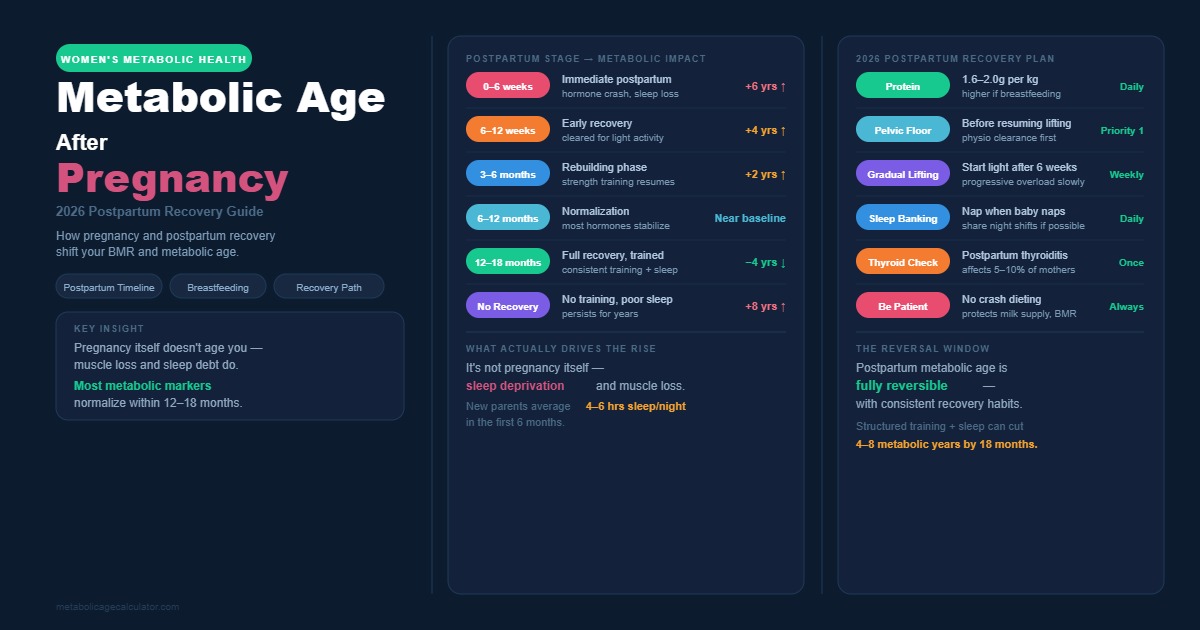
Your metabolic age after pregnancy rises for most new mothers. Pregnancy lowers muscle mass, shifts hormone levels, and slows resting calorie burn for weeks after delivery. You can lower your metabolic age after pregnancy again within 3 to 6 months through 4 targeted actions: muscle rebuilding, protein adjustment, sleep repair, and hydration.
What Is Metabolic Age After Pregnancy?
Metabolic age after pregnancy is a comparison score. It matches your postpartum basal metabolic rate (BMR) against the average BMR of women in your same chronological age group. A metabolic age higher than your real age means your BMR runs below the typical rate for your age bracket. Resting metabolic rate (RMR) research from Western Kentucky University measured a drop from 1,868 kcal per day in late pregnancy to 1,517 kcal per day at 4 to 6 months postpartum, a gap that raises metabolic age until muscle and hormones recover.
Pregnancy raises BMR by 15% to 20% to support fetal growth. Delivery removes that demand within days, but muscle loss, sleep debt, and hormone shifts often push resting calorie burn below the pre-pregnancy baseline. This gap creates a temporary rise in metabolic age that most women can reverse with consistent effort.
Tracking your metabolic age after pregnancy gives you an objective number instead of relying on the bathroom scale alone. Body weight fluctuates daily from fluid shifts and milk production, while a BMR-based metabolic age score isolates the calorie-burning trend underneath those fluctuations.
How Does Pregnancy Change Your Basal Metabolic Rate?
Pregnancy increases basal metabolic rate (BMR) by 15% to 20% during the third trimester. The growing fetus, placenta, and expanded blood volume all require continuous energy, even while you rest.
The increase builds gradually across 3 trimesters. First-trimester BMR rises by only 3% to 5% above baseline. Second-trimester BMR climbs to 8% to 12% above baseline as fetal growth accelerates. Third-trimester BMR reaches the full 15% to 20% increase, driven by peak fetal, placental, and maternal tissue demands.
Three systems drive this increase:
- The placenta, which functions as an active endocrine organ and burns calories around the clock
- Increased maternal blood volume, which rises by 1.2 to 1.6 liters (40 to 54 fl oz) by the third trimester
- Elevated thyroid hormone output, which speeds cellular metabolism throughout pregnancy
Your BMR peaks in the final 6 weeks before delivery. It then drops sharply within 48 hours after birth, once the placenta delivers and blood volume normalizes.
Why Does Your Metabolism Slow Down After Childbirth?
Your metabolism slows down after childbirth because 3 factors reverse at once: hormone levels fall, muscle mass drops, and sleep quality declines. Each factor independently lowers resting calorie burn.
Muscle tissue burns 6 to 10 calories per pound (13 to 22 calories per kg) daily at rest, while fat tissue burns only 2 to 3 calories per pound (4 to 7 calories per kg). Pregnancy and the early postpartum period commonly reduce lean muscle mass by 5% to 8%, driven by reduced activity in the third trimester and the first 6 weeks after delivery.
Sleep quality declines sharply after birth. Newborns wake every 2 to 3 hours for feeding, which fragments deep sleep cycles for the first 3 to 4 months. Fragmented sleep raises cortisol and lowers growth hormone output, both of which slow muscle repair and reduce resting calorie burn further.
The Role of Estrogen and Progesterone Drops
Estrogen and progesterone fall sharply within 72 hours of delivery. Estrogen regulates how efficiently your body converts food into usable energy. Progesterone supports normal thyroid function, the gland that sets your metabolic pace.
This dual hormone drop slows resting calorie burn for 6 to 12 weeks in most women. Levels typically stabilize by week 12 postpartum, though breastfeeding extends suppressed estrogen levels beyond that window.
Postpartum Thyroiditis and Metabolic Age
Postpartum thyroiditis affects 5% to 10% of new mothers between month 1 and month 6 after delivery. This condition first raises thyroid hormone output, then causes a temporary underactive phase that can lower BMR by 10% to 20%.
Request a thyroid-stimulating hormone (TSH) blood test if fatigue, unexplained weight gain, or a metabolic age 10 or more years above your chronological age persists past week 12 postpartum.
Most cases of postpartum thyroiditis resolve within 12 to 18 months without permanent treatment. A smaller group of women, roughly 20% of those affected, develop lasting hypothyroidism and need ongoing thyroid hormone replacement. Annual TSH monitoring after a postpartum thyroiditis diagnosis catches this transition early.
How Long Does Metabolic Age After Pregnancy Last?
Metabolic age after pregnancy typically returns to your pre-pregnancy baseline within 3 to 6 months. Full recovery depends on muscle rebuilding speed, sleep quality, and breastfeeding status.
The 25-participant Western Kentucky University cohort found that RMR measured 4 to 6 months postpartum remained lower than late-pregnancy RMR even after adjusting for body weight. This drop reflects normal hormone stabilization, not a permanent metabolic injury.
Timeline for Vaginal Delivery vs Cesarean Recovery
Vaginal delivery allows resistance training to resume within 4 to 6 weeks for most women, once a clinician confirms healing. Cesarean delivery adds 2 to 4 extra weeks before core and lower-body strength training resumes safely.
Both delivery types show similar hormone-driven increases in metabolic age during the first 6 weeks. Recovery speed then depends more on muscle rebuilding than on the delivery method itself.
Walking remains safe for both delivery types starting within the first 1 to 3 days, as tolerated. Gentle walking maintains circulation, supports digestion, and preserves a small amount of daily calorie burn while formal exercise waits for clinical clearance.
How Does Breastfeeding Affect Your Metabolic Age?
Breastfeeding burns 300 to 500 extra calories per day, which raises total daily energy expenditure (TDEE) without changing BMR directly. This extra calorie burn does not automatically lower your metabolic age.
Breastfeeding also keeps estrogen suppressed to support milk supply. Suppressed estrogen slows fat metabolism by up to 15%, which can offset the calorie-burning benefit of lactation. Increased hunger and carbohydrate cravings during breastfeeding often push intake past the extra 300 to 500 calories burned, which limits metabolic age improvement until weaning or supply stabilizes around month 9 to 12.
Weaning triggers a second hormone shift as estrogen rises back toward baseline over 4 to 8 weeks. Many mothers see their metabolic age improve during this window, since restored estrogen supports fat metabolism again while established exercise habits are already in place.
What Nutrients Support Postpartum Metabolic Recovery?
Iron, omega-3 fatty acids, and vitamin D support postpartum metabolic recovery by correcting 3 common deficiencies that slow BMR. Fixing these deficiencies through diet or supplementation restores normal thyroid and muscle function faster than exercise alone.
Correct Iron Deficiency After Blood Loss
To correct iron deficiency after delivery, request a ferritin test at your 6-week postpartum visit, since blood loss during birth commonly lowers iron stores by 500 to 1,000 mg. Low iron reduces oxygen delivery to muscle tissue, which lowers exercise capacity and slows BMR recovery.
Add Omega-3s and Vitamin D for Thyroid Support
Add 250 to 500 mg of combined EPA and DHA omega-3 fatty acids daily to support thyroid hormone conversion. Vitamin D levels below 20 ng/mL (50 nmol/L) correlate with slower postpartum weight loss and higher rates of postpartum thyroiditis, so request a vitamin D test alongside your TSH panel.
How to Lower Your Metabolic Age After Pregnancy
To lower your metabolic age after pregnancy, combine 4 actions: rebuild muscle, raise protein intake, repair sleep debt, and stay hydrated. Each action targets a different cause of postpartum metabolic slowdown.
Rebuild Muscle Mass Safely Postpartum
To rebuild muscle mass safely postpartum, start with 2 bodyweight sessions per week at week 6, then add resistance bands and light dumbbells by week 10. Each pound of muscle regained raises BMR by 6 to 10 calories daily.
Focus on 3 compound movements: squats, glute bridges, and rows. These exercises rebuild core and pelvic floor stability lost during pregnancy while also raising resting calorie burn.
Progress gradually over 12 weeks: bodyweight only for weeks 6 to 8, resistance bands for weeks 8 to 10, and light dumbbells of 5 to 10 lbs (2.3 to 4.5 kg) from week 10 onward. Increase load only after 2 consecutive sessions feel comfortable at the current level.
Adjust Protein and Calorie Intake for Recovery
To adjust protein intake for metabolic recovery, target 1.6 to 2.2 grams of protein per kilogram (0.7 to 1 gram per pound) of bodyweight daily. Protein carries a thermic effect of 20% to 30%, meaning your body burns up to a third of those calories during digestion alone. Use a calorie deficit calculator to confirm your intake still covers the extra 400 to 500 calories breastfeeding requires, since eating too little slows muscle repair and extends recovery time.
Fix Sleep Debt to Protect Your Metabolic Rate
To fix sleep debt after childbirth, protect 1 block of 4 to 5 consecutive hours of sleep nightly through partner support or scheduled naps. Five nights of 6-hour sleep reduces insulin sensitivity by 25%, which slows fat metabolism and raises metabolic age.
Cortisol rises with chronic sleep deprivation and breaks down muscle tissue for energy. This process directly lowers BMR and works against every other recovery step you take.
Stay Hydrated to Support Resting Calorie Burn
To support resting calorie burn through hydration, drink 2 to 3 liters (68 to 101 fl oz) of water daily, plus an extra 700 ml (24 fl oz) if breastfeeding. Drinking 500 ml (17 fl oz) of cold water raises BMR by a measurable amount for roughly 60 minutes through a process called water-induced thermogenesis.
Chronic mild dehydration slows metabolic rate and increases fatigue, which then reduces daily movement and calorie burn. Keep a marked water bottle within reach during feeding sessions to track intake accurately.
When Should You Test Your Metabolic Age After Having a Baby?
Test your metabolic age no earlier than 6 weeks postpartum, once bleeding stops and hormone levels begin stabilizing. Testing too early during acute hormone shifts gives an inaccurate baseline reading.
Retest every 90 days after the initial 6-week test. Muscle takes 8 to 12 weeks to measurably raise BMR, so 90-day intervals show whether your recovery plan works. Pair your metabolic age result with a free body fat calculator for a fuller picture of body composition changes during recovery.
Test under consistent conditions each time: first thing in the morning, before eating, and after emptying your bladder. Consistent timing removes hydration and digestion as variables, so any change in your result reflects a real shift in BMR rather than measurement noise.
What Does a Week-by-Week Postpartum Recovery Plan Look Like?
A week-by-week postpartum recovery plan sequences 7 tasks by healing stage, starting at week 1 and extending through month 6. Follow the table below as a general guide, confirm timing with your clinician, and revisit your macro calculator tool once training volume increases.
|
Task |
Timing |
Method |
Difficulty |
|
Short daily walks |
Week 1-2 postpartum |
10-20 minute walks, 1-2 times daily |
Easy |
|
Pelvic floor activation |
Week 2-4 postpartum |
Guided breathing and Kegel sets |
Easy |
|
First metabolic age retest |
Week 6 postpartum |
Online calculator or smart scale |
Easy |
|
Bodyweight strength training |
Week 6-8 postpartum |
2 sessions per week, full body |
Moderate |
|
Resistance training with weights |
Week 8-12 postpartum |
2-3 sessions per week |
Moderate |
|
Second metabolic age retest |
Month 3 postpartum |
Same calculator, same conditions |
Easy |
|
Macro and calorie plan review |
Month 3-6 postpartum |
Macro calculator tool |
Moderate |
Frequently Asked Questions
Does Metabolic Age Go Back to Normal After Pregnancy?
Yes. Metabolic age returns to your pre-pregnancy baseline within 3 to 6 months for most women, once hormone levels stabilize and muscle mass rebuilds.
Can Breastfeeding Lower My Metabolic Age?
Not directly. Breastfeeding burns 300 to 500 extra calories daily, but suppressed estrogen during lactation can offset that benefit until milk supply stabilizes around month 9 to 12.
Is a High Metabolic Age After Birth Dangerous?
No. A temporary rise in metabolic age after childbirth reflects normal hormone shifts, not a medical emergency. Persistent fatigue past week 12 warrants a thyroid-stimulating hormone (TSH) test.
How Many Calories Does Postpartum Muscle Loss Cost Daily?
60 to 100 calories daily. Losing 5% to 8% of muscle mass during pregnancy and early postpartum recovery lowers BMR by that amount, based on 6 to 10 calories burned per pound of muscle.
When Can I Safely Start Exercising to Lower My Metabolic Age?
Week 6 postpartum for most vaginal deliveries. Cesarean delivery typically adds 2 to 4 extra weeks before core and lower-body training resumes, pending clinician clearance.
Key Takeaways for Your Postpartum Metabolic Recovery
Your metabolic age after pregnancy climbs for a predictable, temporary set of reasons: hormone shifts, muscle loss, and sleep debt. None of these causes signal permanent damage, and each one responds to a specific, well-documented action.
Track your BMR every 90 days, prioritize protein and resistance training, and expect your score to normalize within 3 to 6 months. Check your current number and compare it against your pre-pregnancy baseline with the ideal body weight calculator to build a complete recovery picture in 2026.