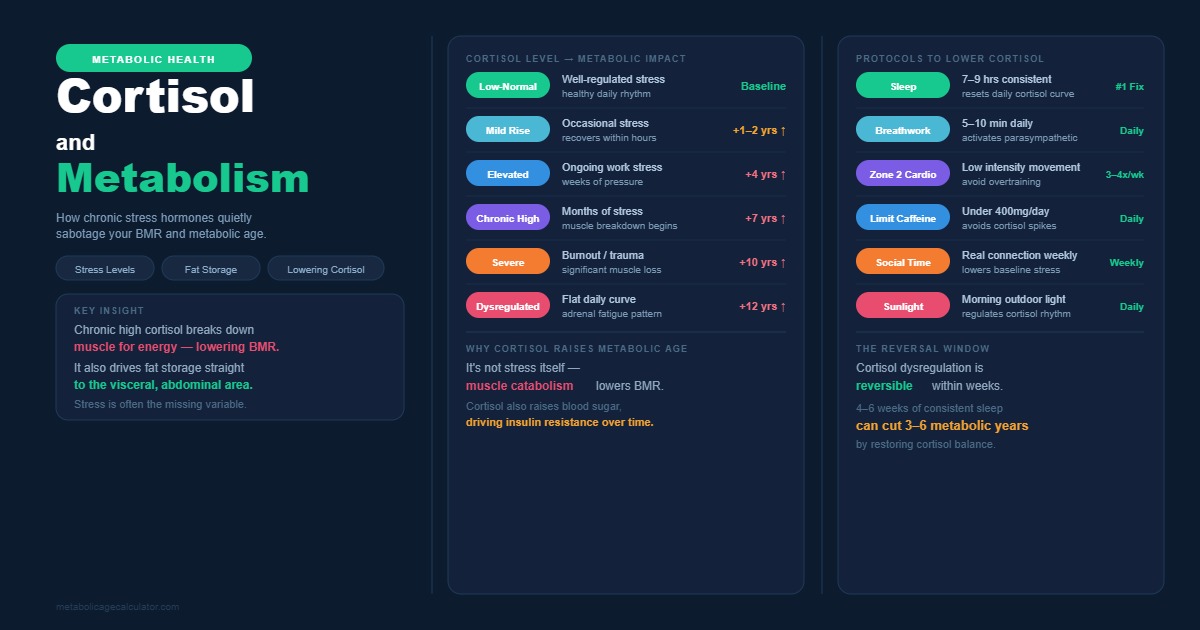
Cortisol and metabolism share a direct link. High cortisol slows your resting calorie burn and prompts fat storage. Chronic stress keeps cortisol elevated, and that steady elevation lowers your basal metabolic rate (BMR) over time. Your body treats stress as an emergency signal. Short bursts of cortisol help you react fast. Constant release wears down the systems that keep your metabolism running at full speed. This guide explains how cortisol and metabolism interact, plus the exact steps that lower cortisol and restore your metabolic rate.
How Are Cortisol and Metabolism Connected?
Cortisol raises blood sugar, triggers abdominal fat storage, and lowers your resting calorie burn. The adrenal glands, 2 small organs sitting above your kidneys, release cortisol during physical or emotional stress. Cortisol then binds to receptors in your liver, muscle, and fat tissue, changing how each organ uses energy.
Cortisol and metabolism intersect at 3 main points: glucose production, protein breakdown, and fat distribution. Your liver produces new glucose through a process called gluconeogenesis, giving you fast fuel during a threat. Your muscle tissue breaks down for amino acids. Your fat cells shift storage toward your abdomen instead of your hips or thighs.
Cortisol-driven fat storage favors visceral fat over subcutaneous fat. Visceral fat sits around your liver, pancreas, and intestines, not just under your skin. This type of fat carries a higher risk for heart disease and type 2 diabetes. Fat stored on your hips or thighs carries less risk in comparison.
Cortisol differs from adrenaline, the other major stress hormone your adrenal glands release. Adrenaline acts within seconds and clears your system within minutes. Cortisol acts more slowly and can stay elevated for hours, days, or months. That extended duration is exactly why cortisol does more long-term metabolic damage than a single adrenaline spike.
Short-term cortisol spikes help you handle single stressful events, such as a work deadline or a near miss. Chronic stress, though, keeps cortisol high for weeks or months, and your metabolism pays the price. The Endocrine Society lists chronic cortisol elevation among the most common hormonal drivers of unexplained weight gain. Clinicians increasingly screen for it before assuming diet or exercise habits alone explain a stalled metabolism.
What Happens to Your Body When Cortisol Stays Chronically High?
Chronically high cortisol disrupts your blood sugar control, breaks down muscle tissue, and blunts your natural hormone rhythm. Cortisol and metabolism interact most sharply through these 2 systems, detailed below. These systems explain most of the slowdown people experience under long-term stress.
The HPA Axis Controls Your Cortisol Release
The hypothalamic-pituitary-adrenal (HPA) axis governs how much cortisol your body produces. Your hypothalamus senses stress first and signals your pituitary gland. Your pituitary gland then releases adrenocorticotropic hormone (ACTH), which travels to your adrenal glands and triggers cortisol release.
This 3-step loop normally shuts itself off once the stressor passes. Cortisol reaches your brain, tells your hypothalamus to stop signaling, and levels fall within hours. Chronic stress interrupts that feedback loop, and cortisol stays elevated instead of returning to baseline. Over months, constant signaling can blunt your natural morning cortisol peak. That peak normally gets you alert and ready to burn calories.
Cortisol's Direct Effect on Insulin and Blood Sugar
Cortisol blocks insulin's normal action, which raises blood sugar during stress. Elevated cortisol reduces how well insulin moves glucose into your muscle and fat cells. Your pancreas then releases more insulin to compensate, and that combination promotes insulin resistance over months.
Insulin resistance forces your body to store more calories as fat instead of burning them for energy. High blood sugar also triggers cravings for sugary and high-fat foods, such as pastries, chips, and fast-food burgers. Those cravings add calories on top of an already slower metabolism. Left unmanaged for 1 to 2 years, this cycle raises your risk for prediabetes and type 2 diabetes.
How Chronic Stress Disrupts Your Metabolic Rate
Chronic stress lowers your metabolic rate mainly by shrinking muscle tissue and suppressing thyroid hormone output. Both effects reduce the total calories your body burns each day at rest.
Cortisol Breaks Down Muscle Tissue and Lowers BMR
Cortisol breaks down muscle protein for fuel, and less muscle means a lower BMR. Muscle tissue burns roughly 13 calories per kilogram (about 6 calories per pound) each day at rest. Fat tissue burns closer to 4.5 calories per kilogram (about 2 calories per pound).
Chronic cortisol exposure shifts your body composition toward more fat and less muscle. That shift alone can lower your BMR by a measurable amount over a year. A loss of just 2.3 kilograms (about 5 pounds) of muscle can lower daily calorie burn by 30 calories. Reversing the pattern requires resistance training and enough protein to rebuild what cortisol breaks down. Our muscle mass and metabolism guide walks through exact protein targets and training splits for your age and activity level.
Cortisol Disrupts Thyroid Hormone Production
Cortisol suppresses thyroid-stimulating hormone (TSH) and slows conversion of T4 into active T3. Your thyroid gland controls the pace of nearly every metabolic process in your body. Lower active thyroid hormone means fewer calories burned per day, even during identical activity levels.
Symptoms of cortisol-driven thyroid suppression include fatigue, cold hands and feet, and slow digestion. A blood panel measuring TSH, free T3, and free T4 confirms whether thyroid changes are contributing to your slower metabolism.
How Do Age and Sex Change This Relationship?
Your age and sex both change how much a given cortisol level affects your metabolism. Hormones, muscle mass, and stress patterns each shift the equation differently.
Estrogen normally buffers cortisol's effect on fat storage, so premenopausal women store less visceral fat under equal stress. That protection fades after menopause, when estrogen drops and cortisol's fat-storing effect strengthens around the abdomen.
Men typically show higher cortisol reactivity to a single acute stressor than women, based on endocrine research. Women report chronic stress more often in health surveys, which extends cortisol elevation over more days each month. Both patterns push toward the same outcome: elevated cortisol, a slower BMR, and more visceral fat.
Aging adds a separate layer. Cortisol output stays roughly stable across adulthood. Muscle mass, though, declines by 3 to 8 percent per decade after age 30 without resistance training. Less muscle means a lower baseline BMR. The same cortisol level then does more metabolic damage at age 50 than at age 25. Check your numbers against typical ranges for your decade if you are past 40 and tracking unexplained weight gain. Metabolic age tracking becomes useful during this transition since it separates true aging from a temporary cortisol slowdown.
What Are the Warning Signs of Cortisol-Driven Metabolic Slowdown?
7 warning signs point to cortisol-driven metabolic slowdown.
- Stubborn belly fat
- Constant fatigue
- Sugar cravings
- Poor sleep
- Brain fog
- Slow wound healing
- Frequent illness
Each signal reflects a different downstream effect of chronically high cortisol.
Stubborn abdominal fat resists diet and exercise because cortisol specifically directs fat storage toward your visceral cavity. Constant fatigue develops once your adrenal rhythm flattens and your morning cortisol peak weakens. Sugar cravings intensify as your brain seeks fast glucose to offset insulin resistance.
Poor sleep and high cortisol reinforce each other in a loop that is hard to break without intervention. Brain fog stems from cortisol's effect on your hippocampus, a brain region tied to memory and focus. Slow wound healing and frequent illness both point to suppressed immune function. Cortisol dampens inflammatory response when levels stay high for months. Most people notice 3 or more of these 7 signs together before they connect the pattern back to stress. Track these 7 signs over 2 to 4 weeks rather than judging a single day.
How to Lower Cortisol and Protect Your Metabolism
To lower cortisol and protect your metabolism, combine daily stress habits with targeted nutrition and sleep changes. No single fix works alone; the combination compounds over 4 to 8 weeks. Cortisol and metabolism both respond fastest when sleep changes come first, before diet or supplements. For a complete plan to lower your metabolic age, pair these habits with consistent resistance training.
4 Daily Habits That Lower Cortisol Naturally
4 daily habits lower cortisol most reliably: consistent sleep, morning sunlight, moderate exercise, and structured breathing practice.
Consistent sleep of 7 to 9 hours keeps your cortisol rhythm steady. Morning sunlight exposure for 10 to 15 minutes helps reset your circadian clock and morning cortisol peak. Moderate exercise, such as brisk walking, cycling, or swimming, lowers cortisol without triggering an added stress response. Structured breathing practice, including 4-7-8 breathing for 5 minutes twice daily, activates your parasympathetic nervous system directly.
2 Supplements Backed by Research
2 supplements show measurable cortisol reduction in clinical studies: ashwagandha and omega-3 fatty acids. Ashwagandha root extract lowers cortisol by 20 to 30 percent when taken daily for 8 weeks, based on published trials. Omega-3 fatty acids from fish oil reduce inflammatory markers that otherwise amplify cortisol's metabolic effects.
Talk with your doctor before starting either supplement, especially if you take thyroid or blood pressure medication. Limit caffeine after 2 p.m. as well, since a late dose can raise cortisol during hours when it should naturally be falling.
Quick-Reference: Cortisol Management Actions for a Faster Metabolism
The table below turns each strategy from this guide into a simple action plan. Start with the easy tasks, then layer in the moderate ones over your first month.
|
Task |
Timing |
Method |
Difficulty |
|
Sleep 7 to 9 hours |
Nightly |
Fixed bedtime, dark cool room |
Easy |
|
Morning sunlight |
10 to 15 min, AM |
Outdoor walk, no sunglasses |
Easy |
|
Moderate exercise |
30 to 45 min, 5x/week |
Brisk walking, cycling, or swimming |
Moderate |
|
Breathing practice |
5 min, 2x/day |
4-7-8 breathing technique |
Easy |
|
Ashwagandha |
Daily, for 8 weeks |
300 to 600mg root extract |
Moderate |
|
Resistance training |
2 to 3x/week |
Squats, rows, and presses |
Moderate |
|
Thyroid panel test |
Once, if symptoms persist |
Blood draw at a lab |
Easy |
Easy tasks build the foundation for the moderate ones. Sleep and morning sunlight cost nothing and take under 15 minutes combined each day. Moderate tasks, such as resistance training and ashwagandha, need more planning. These tasks produce the largest measurable change in your BMR over 8 to 12 weeks.
How to Test Whether Cortisol Is Slowing Your Metabolism
To test whether cortisol is slowing your metabolism, combine a cortisol lab panel with a direct BMR measurement. A morning blood or saliva cortisol test, paired with a BMR calculation, gives the clearest picture.
Salivary cortisol testing captures 4 samples across a single day: waking, midday, evening, and bedtime. This 4-point curve reveals whether your rhythm has flattened, a hallmark of chronic stress. A single blood draw only captures 1 moment and can miss the pattern entirely. Home saliva test kits now let you collect all 4 samples without a lab visit, then mail them for analysis.
Once you have your cortisol results, compare them against your BMR using the Mifflin-St Jeor equation. If your BMR sits below the expected range for your age and body size, cortisol may be a contributing factor. Check where you stand by reviewing what metabolic age means for your specific numbers, then track changes every 90 days.
Frequently Asked Questions About Cortisol and Metabolism
Does high cortisol always cause weight gain?
No, high cortisol does not always cause weight gain. Individual response depends on genetics, baseline body composition, and how long cortisol stays elevated. Some people show blood sugar changes first, with weight gain following only after months of chronic stress. Genetics alone can account for a meaningful share of that variation between 2 people under identical stress.
Can lowering cortisol speed up your metabolism?
Yes, lowering cortisol can speed up your metabolism within 8 to 12 weeks. Reduced cortisol allows muscle tissue to rebuild, insulin sensitivity to improve, and thyroid hormone conversion to normalize. Consistent sleep and resistance training produce the fastest measurable change. Most people notice better energy within 2 weeks, well before the scale moves.
How long does it take for cortisol to return to normal?
Cortisol typically returns to a normal daily rhythm within 2 to 6 weeks of consistent stress reduction. Acute spikes resolve within hours once a stressor ends. Chronic elevation from ongoing stress takes longer because the HPA axis needs repeated calm signals to reset.
Is cortisol testing accurate for tracking metabolism?
Yes, cortisol testing accurately tracks trends when you repeat the same test method over time. Saliva testing works well for rhythm tracking across a full day. Single blood draws work best for confirming a specific high or low reading rather than tracking daily patterns.
Does exercise raise or lower cortisol?
Exercise can raise or lower cortisol depending on intensity and duration. Moderate exercise for 30 to 45 minutes lowers cortisol and supports your metabolism. Intense exercise beyond 90 minutes without adequate recovery raises cortisol and can slow fat loss. Pair hard training days with 1 full rest day to keep cortisol from staying elevated.
Cortisol and metabolism stay connected for as long as chronic stress continues, but the relationship is reversible. Consistent sleep, moderate exercise, and 2 research-backed supplements bring cortisol back into a normal range within weeks. Muscle rebuilds, insulin sensitivity improves, and your resting calorie burn recovers step by step.
Start by running your numbers through our free calorie deficit calculator. Track your BMR every 90 days as cortisol stabilizes, and adjust your habits based on what the trend shows. Small, consistent changes beat drastic overhauls for cortisol regulation every time.