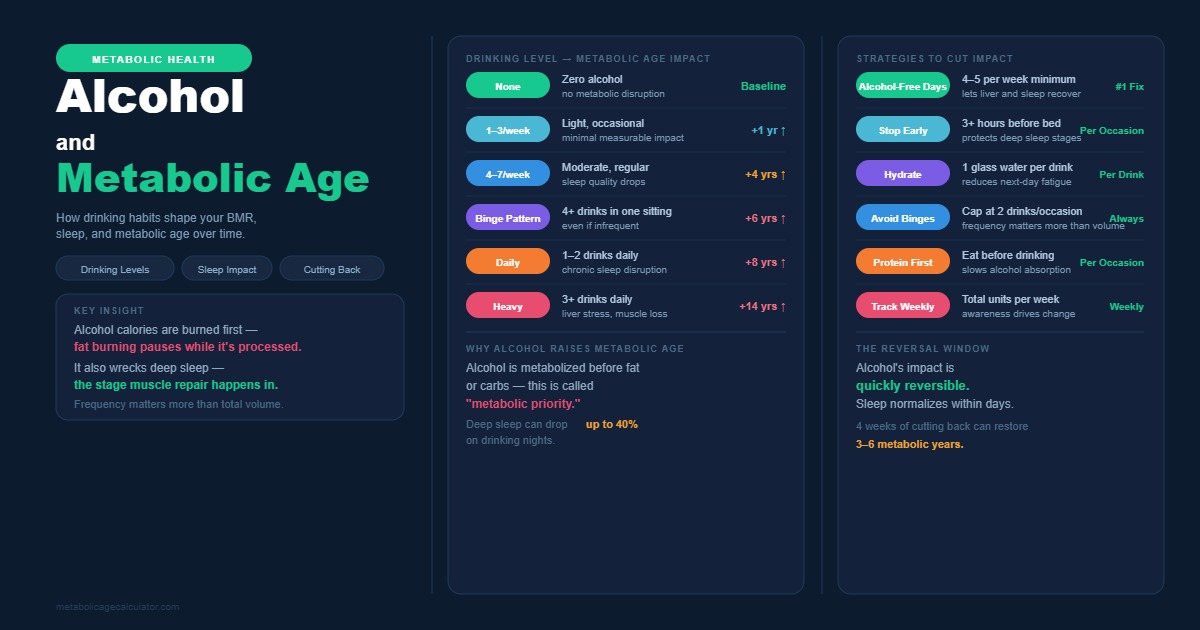
Alcohol and metabolic age share a direct connection. Regular drinking lowers your Basal Metabolic Rate (BMR) and raises your metabolic age above your true age.
Your liver treats ethanol as a toxin and stops processing fat, protein, and carbohydrates until it clears the alcohol first. This delay slows fat burning, disrupts hormone balance, and leads to excess calories that your body stores rather than burning. You reverse much of this damage once you understand the exact mechanism and make 3 specific changes to your drinking pattern in 2026.
Millions of adults track their metabolic age with calculators and smart scales, yet few connect their results to weekly drinking totals. This guide breaks down the science, gives you exact numbers, and shows you the fastest path back to a younger metabolic age.
Doctors in the US, UK, and Canada increasingly ask patients about weekly drink totals during metabolic health screenings. Your answer directly predicts how far your BMR sits below your genetic potential, making alcohol 1 of the most controllable factors in your metabolic age result.
What Is the Link Between Alcohol and Metabolic Age?
Alcohol raises your metabolic age by lowering your BMR and increasing fat storage around your organs. Metabolic age compares your BMR to the average BMR of people in different age groups. A lower BMR pushes your result into an older age bracket, even if your chronological age stays the same.
Ethanol supplies 7 calories per gram, more than carbohydrates or protein but less than fat. Your body cannot store ethanol the way it stores fat, so your liver processes it immediately. This process, called the metabolic priority effect, forces your liver to pause normal fat oxidation for 2 to 3 hours after 1 drink.
Frequent drinkers show a measurable pattern: lower resting energy expenditure, higher visceral fat, and reduced muscle mass. Each factor lowers BMR independently, and together they compound your metabolic age result. Check your BMR versus RMR guide to see where your baseline stands before you change your drinking habits.
Genetics also shapes your personal risk. People with fast-working alcohol dehydrogenase and slow-working aldehyde dehydrogenase clear acetaldehyde poorly, extending the metabolic slowdown window. This group often shows steeper increases in metabolic age for the same weekly drink total as their peers.
How Does Alcohol Slow Down Your Basal Metabolic Rate?
Alcohol slows your BMR by forcing your liver to prioritize ethanol breakdown over fat and carbohydrate metabolism. Your liver holds 2 primary enzymes for this task: alcohol dehydrogenase (ADH) and aldehyde dehydrogenase (ALDH).
Why the Liver Prioritizes Alcohol Over Fat and Carbs
To process alcohol, your liver converts ethanol into acetaldehyde using ADH, then converts acetaldehyde into acetate using ALDH. Your body treats acetaldehyde as toxic and clears it before touching stored fat. Fat oxidation drops sharply within hours of a single drink, based on published metabolic studies.
Your liver can only process roughly 1 standard drink per hour regardless of body size. Any alcohol beyond that rate circulates in your bloodstream, extending the time your fat-burning systems stay paused. Drinking 3 drinks in 1 hour therefore pauses fat oxidation for close to 3 times as long as 1 drink.
How Acetaldehyde Disrupts Normal Energy Production
Acetaldehyde raises your NADH-to-NAD+ ratio inside liver cells. This shift blocks gluconeogenesis, the process your liver uses to create glucose from protein and fat. Your blood sugar drops, your energy output slows, and your body pulls from muscle glycogen instead of fat stores.
This same NADH shift also slows the Krebs cycle, the core pathway your cells use to convert nutrients into usable energy. A slower Krebs cycle means fewer calories burned per hour, even while you sit still watching television.
Does Moderate Drinking Raise or Lower Your Metabolism?
Moderate drinking can temporarily raise metabolic rate through thermogenesis, but frequent moderate drinking still lowers BMR over time. The outcome depends entirely on frequency and total volume, not on a single occasion.
Effects of 1-2 Standard Drinks on BMR
A single standard drink (14 grams or 0.6 fluid ounces of pure alcohol) can raise short-term energy expenditure by roughly 10% for 2 to 3 hours. This effect comes from the extra work your liver performs, not from fat burning. The calorie surplus from the drink itself cancels out any thermogenic gain, leaving no net benefit for weight management.
Women process alcohol more slowly than men due to lower levels of stomach ADH enzyme and typically smaller liver mass. A woman drinking the same 2 standard drinks as a man experiences a longer BMR disruption window, often by 20% to 30%.
Effects of Heavy or Binge Drinking on BMR
Heavy drinking, defined as 4 or more drinks in a single session, suppresses fat oxidation for up to 24 hours. Repeated binge sessions damage liver enzyme efficiency and lower baseline BMR within 8 to 12 weeks. Chronic heavy drinkers show BMR readings 5% to 10% lower than non-drinkers matched for age, sex, and weight.
Binge drinking also triggers a rebound cortisol spike the following day, commonly called the next-day stress response. This spike raises blood sugar, increases fat storage signals, and adds to the cumulative BMR damage from the drinking session itself.
How Alcohol Increases Your Metabolic Age Over Time
Alcohol increases metabolic age by shrinking muscle mass and expanding visceral fat, both of which drive down your resting calorie burn. Muscle tissue burns more calories at rest than fat tissue, so any muscle loss directly lowers BMR.
Alcohol, Visceral Fat, and Muscle Loss
Alcohol blocks muscle protein synthesis for up to 24 hours after drinking, based on controlled trials involving resistance-trained adults. Cortisol rises with regular drinking, and elevated cortisol breaks down muscle tissue while storing fat around your abdomen. Visceral fat, unlike subcutaneous fat, releases inflammatory compounds that further suppress metabolic function.
Alcohol also disrupts ghrelin and leptin, the hormones that control hunger and fullness. Disrupted hormone signals lead to late-night snacking, higher total calorie intake, and reduced sleep quality. Poor sleep alone can lower BMR by 2% to 5%, adding a second pathway toward a higher metabolic age.
Long-Term Organ and Hormone Effects
Chronic drinking reduces testosterone in men and disrupts estrogen balance in women, both hormones that support muscle maintenance. Reduced sex hormone output compounds the muscle loss already caused by blocked protein synthesis. Over 5 to 10 years, this combination can raise metabolic age by 5 to 15 years beyond chronological age in heavy drinkers.
Alcohol also damages liver cells directly through fat accumulation, a condition doctors call alcoholic fatty liver. A fatty liver processes nutrients less efficiently, lowering the organ's contribution to your total daily energy expenditure. Since your liver accounts for a significant share of resting calorie burn, even mild fatty liver changes measurably lower BMR.
How to Calculate Your BMR After Regular Drinking
To calculate your BMR after regular drinking, use the Mifflin-St Jeor formula with your current weight, height, and age. Standard BMR calculators do not subtract alcohol's direct impact, so treat the result as your baseline, not your drinking-adjusted number.
Enter your data into a smart scale or online calculator to get your starting BMR figure. Compare that number against the BMR versus RMR guide to confirm you read the correct metric for your specific goal.
Track your BMR every 4 weeks, ideally using smart scale BMR readings taken under identical conditions, to see how reduced drinking shifts your result.
Test your BMR only after 24 hours of complete abstinence for accuracy. Alcohol acts as a diuretic and changes hydration status, which skews bioelectrical impedance readings on smart scales by up to 10%. Understanding your personal alcohol and metabolic age numbers gives you a measurable target to track month over month.
How to Lower Your Metabolic Age If You Drink Regularly
You lower your metabolic age fastest by cutting drinking frequency and rebuilding muscle mass simultaneously. Neither change alone produces the same result as combining both.
Cut Back Using the 3-Drink Weekly Rule
Limit total intake to 3 standard drinks per week if your metabolic age currently sits above your chronological age. This threshold keeps liver enzyme function stable while still allowing occasional social drinking. Replace 2 of your usual drinking days with alcohol-free days to give your liver full recovery time between sessions.
Rebuild Muscle to Offset Alcohol-Related BMR Loss
Add 2 to 3 resistance training sessions per week, targeting major muscle groups such as legs, back, and chest. Muscle tissue burns roughly 6 calories per pound (13 calories per kilogram) daily at rest, compared to 2 calories per pound (4.5 calories per kilogram) for fat tissue. Pair training with 1 gram of protein per pound (2.2 grams per kilogram) of body weight daily to support muscle repair.
Support Liver Recovery With Sleep and Hydration
Sleep 7 to 9 hours nightly to allow cortisol levels to normalize and support muscle repair hormones. Drink 3 liters (100 fl oz) of water daily to help your liver clear residual acetaldehyde faster between drinking days. Both habits accelerate the BMR recovery timeline beyond cutting alcohol alone.
If your metabolic age has not improved after 12 weeks of consistent changes, request a full thyroid panel from your doctor. Review strategies to lower your metabolic age for a complete 8-step plan that extends beyond alcohol reduction alone.
How Long Does It Take Your Metabolism to Recover After Quitting Alcohol?
Your BMR begins recovering within 2 weeks of quitting alcohol, with full liver enzyme normalization taking 4 to 12 weeks. Recovery speed depends on your prior drinking volume, age, and baseline liver health.
Liver inflammation markers drop within 7 to 14 days of abstinence in most healthy adults. Cortisol levels normalize within 3 to 4 weeks, restoring healthier sleep and reducing abdominal fat storage. Full BMR recovery, including rebuilt muscle protein synthesis rates, typically takes 8 to 12 weeks with consistent resistance training.
People over age 50 recover BMR more slowly than younger adults due to naturally declining liver enzyme activity. Add 4 to 6 extra weeks to the recovery timeline if you fall into this age group. Patience during this window pays off, since the alcohol and metabolic age link reverses fully once liver enzymes normalize.
How Do Different Types of Alcohol Compare for Metabolic Impact?
Beer, wine, spirits, and cocktails affect BMR differently based on sugar content, alcohol percentage, and serving size, not just alcohol volume alone. Comparing drinks by standard serving size gives you the most accurate picture of true metabolic cost.
Beers such as lagers, stouts, and wheat beers carry 4% to 8% alcohol by volume plus residual carbohydrates from the brewing process. These carbohydrates add calories on top of the ethanol load, compounding the BMR slowdown beyond what pure alcohol content suggests. Wines such as reds, whites, and sparkling varieties carry less residual sugar than beer but higher alcohol percentages near 12% to 14%.
Spirits such as vodka, whiskey, and gin contain zero carbohydrates when served neat, making them the lowest-calorie option per unit of alcohol. Cocktails erase this advantage by adding sugary mixers, fruit juices, and syrups that spike blood glucose alongside the alcohol load. A single sugary cocktail can carry 300 to 500 calories, more than double a glass of wine or a serving of spirits.
Frequency matters more than drink choice for your metabolic age result. Switching from beer to spirits without reducing total weekly sessions produces minimal BMR improvement, since the ethanol itself, not just the carbohydrates, drives most of the slowdown. The alcohol and metabolic age relationship stays constant across drink types; only the severity shifts with sugar content.
Quick Reference: Alcohol's Effect on Metabolism by Drink Type
|
Drink Type |
Standard Serving |
BMR Impact |
Recovery Method |
Difficulty |
|
Beer |
12 fl oz (355 ml) |
Moderate slowdown |
Swap 2 nights weekly for water |
Easy |
|
Wine |
5 fl oz (148 ml) |
Moderate slowdown |
Limit to 1 glass with food |
Easy |
|
Spirits (neat) |
1.5 fl oz (44 ml) |
Mild slowdown |
Space drinks 1 hour apart |
Moderate |
|
Cocktails |
8 fl oz (237 ml) average |
Severe slowdown |
Choose sugar-free mixers |
Moderate |
|
Binge session |
4+ drinks |
Severe slowdown |
48-hour full abstinence after |
Hard |
Frequently Asked Questions
Does alcohol permanently lower your metabolic age?
No. The alcohol and metabolic age effect reverses within 8 to 12 weeks of reduced drinking and consistent resistance training.
Can 1 glass of wine per night affect BMR?
Yes. Daily drinking, even at 1 glass, keeps your liver in constant alcohol-processing mode and delays fat oxidation nightly.
Does quitting alcohol speed up metabolism?
Yes. Quitting alcohol restores normal fat oxidation within 2 weeks and improves BMR readings within 8 to 12 weeks.
Is beer worse than wine for metabolic age?
No. Beer and wine affect BMR similarly per standard drink; total volume and frequency matter more than drink type.
Do smart scales detect alcohol's effect on BMR?
Yes. Smart scale BMR readings shift with hydration changes from alcohol, so test only after 24 hours of abstinence for accuracy.
Conclusion
Alcohol and metabolic age move together: every regular drinking session slows your BMR, shrinks muscle mass, and adds visceral fat that ages your metabolism past your real years. You reverse this pattern with 3 fewer weekly drinks, 2 to 3 resistance sessions, and consistent BMR tracking over 12 weeks.
Calculate your current BMR and metabolic age now at the Metabolic Age Calculator to see exactly where your drinking habits have placed you, and start rebuilding a younger metabolic profile today.