If you’ve ever used a calorie calculator or read about metabolism, you’ve almost certainly seen both BMR and RMR thrown around — often as if they mean exactly the same thing. They don’t.
Both numbers describe how many calories your body burns at rest, but they’re measured under different conditions, come out at different values, and are suited to different purposes. Using the wrong one can make your calorie targets or metabolic age estimate meaningless.
This guide breaks down exactly what each number means, which formula science trusts most, and which one to use depending on your goal.
What Is BMR (Basal Metabolic Rate)?
Basal Metabolic Rate is the number of calories your body needs to keep you alive while in a state of complete physiological rest. Think of it as the bare minimum — the energy required to keep your heart beating, lungs breathing, organs functioning, and body temperature stable.
True BMR is measured under very strict clinical conditions:
- After at least 12 hours of fasting
- After a full night’s sleep in a lab environment
- At a thermoneutral room temperature (no shivering or sweating)
- Before any movement or activity
Because these conditions are nearly impossible to replicate in everyday life, true BMR is rarely measured directly outside of research settings. In practice, predictive equations estimate BMR using your age, sex, height, and weight.
BMR accounts for roughly 60–75% of your Total Daily Energy Expenditure (TDEE) — making it the single biggest driver of how many calories you need each day.
What Is RMR (Resting Metabolic Rate)?
Resting Metabolic Rate is similar to BMR, but measured under more relaxed conditions. You don’t need to have slept in a lab overnight. You just need to be rested and calm — no recent intense exercise and no eating for 3–4 hours beforehand.
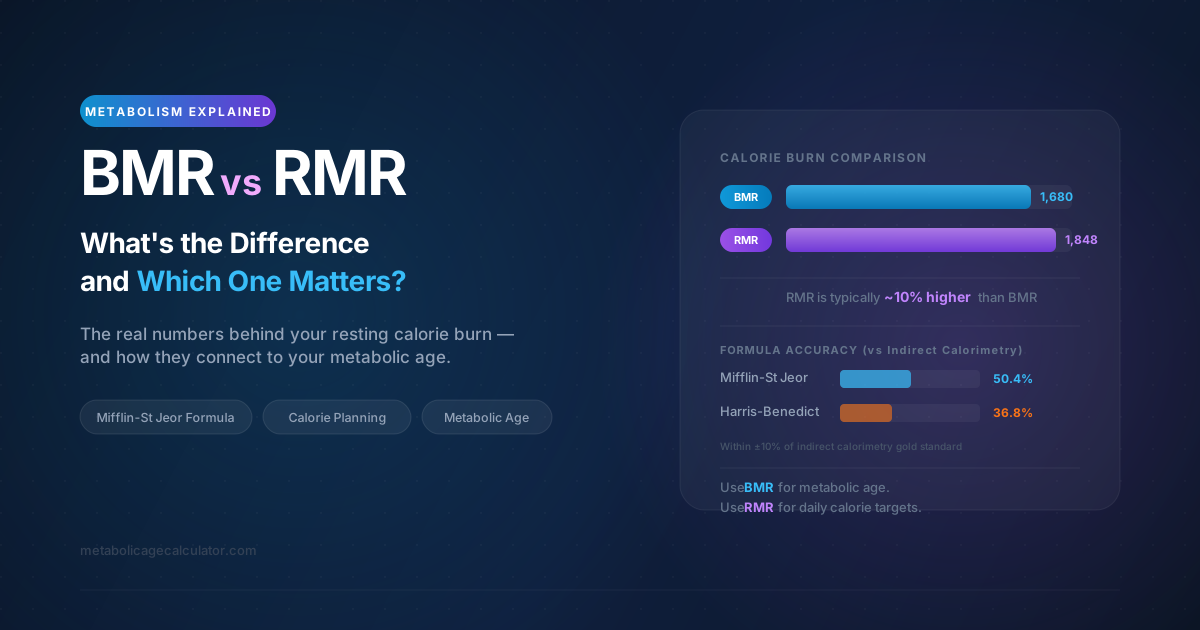
Because it includes a small amount of low-level activity and recent digestion, RMR is typically 5–10% higher than BMR in the same person.
The practical upside: RMR is far easier to test. It’s the measurement used in clinical fitness testing, DEXA scan facilities, and most diet apps — because it reflects what your body actually burns at rest in real-world conditions.
BMR vs RMR: Key Differences at a Glance
| BMR | RMR | |
|---|---|---|
| Full name | Basal Metabolic Rate | Resting Metabolic Rate |
| Measurement conditions | Overnight fast, post-sleep, thermoneutral lab | 3–4 hour fast, rested state |
| Includes digestion energy? | No | Partially |
| Typical value vs the other | Lower baseline | ~5–10% higher |
| Used for | Metabolic age calculations, clinical research | Daily calorie targets, diet planning |
| Easier to measure? | No — very controlled conditions | Yes — standard clinical setting |
| Most common formula | Mifflin-St Jeor, Harris-Benedict | Mifflin-St Jeor, Cunningham |
Which Formula Is Most Accurate?
Both BMR and RMR are typically estimated using predictive equations rather than direct measurement. Two formulas dominate:
Mifflin-St Jeor (1990)
The current gold standard for general use. A 2025 study comparing 9 prediction equations found Mifflin-St Jeor was the most accurate overall — within ±10% of indirect calorimetry measurements for 50.4% of subjects. (Hudak et al., 2025)
For men:
BMR = (10 × weight in kg) + (6.25 × height in cm) − (5 × age in years) + 5
For women:
BMR = (10 × weight in kg) + (6.25 × height in cm) − (5 × age in years) − 161
Harris-Benedict (Revised 1984)
The original classic, revised by Roza and Shizgal. Still widely used, but consistently less accurate than Mifflin-St Jeor — the same 2025 study found Harris-Benedict was within ±10% for only 36.8% of subjects.
For most people calculating metabolic age or planning a diet, Mifflin-St Jeor is the right choice.
Important caveat: Even with the best formula, a landmark systematic review found a 26% unexplained variance in metabolic rate between individuals. Predictive equations give you a solid estimate — not a precise measurement.
Which Number Should You Use?
The answer depends entirely on what you’re trying to accomplish.
Use BMR for Metabolic Age
Metabolic age is calculated by comparing your estimated BMR to the average BMR of people your chronological age. Because metabolic age benchmarks are built using BMR (specifically Mifflin-St Jeor), you need BMR — not RMR — as your input.
Our free metabolic age calculator uses the Mifflin-St Jeor equation to estimate your BMR, then positions your result against population norms to tell you whether your metabolism is younger or older than your biological age.
Use RMR for Daily Calorie Targets
If you’re trying to figure out how many calories to eat — whether for weight loss, maintenance, or muscle gain — RMR is the more practical number. It more accurately reflects your actual resting expenditure under normal daily conditions, which is what diet planning requires.
From your RMR, you then multiply by an activity multiplier (known as the TDEE equation) to estimate your full daily calorie burn:
| Activity Level | Multiplier |
|---|---|
| Sedentary (desk job, no exercise) | RMR × 1.2 |
| Lightly active (exercise 1–3x/week) | RMR × 1.375 |
| Moderately active (exercise 3–5x/week) | RMR × 1.55 |
| Very active (hard exercise 6–7x/week) | RMR × 1.725 |
| Extremely active (athlete or physical job) | RMR × 1.9 |
Why the Difference Matters More Than Most People Think
Here’s a concrete example. A 35-year-old woman, 165 cm, 68 kg:
- Mifflin-St Jeor BMR: ~1,440 kcal/day
- Estimated RMR: ~1,585 kcal/day (10% higher)
If she uses RMR to calculate her metabolic age, her BMR appears inflated — potentially making her metabolic age look several years younger than it actually is. That’s a meaningful error if she’s using the number to track health progress.
Conversely, if she uses BMR for daily calorie planning without accounting for the thermic effect of food and low-level activity, she’ll consistently underestimate her needs — potentially stalling weight loss or leaving her under-fuelled.
Right number, right purpose.
Can You Improve Both BMR and RMR?
Yes — and the strategies are the same, because both ultimately reflect the same underlying biology.
The most impactful changes:
- Build lean muscle mass — muscle tissue burns significantly more calories at rest than fat tissue. Each additional kilogram of muscle raises your BMR by roughly 13 kcal/day.
- Eat enough protein — protein has a higher thermic effect than carbs or fat, and it protects muscle during a calorie deficit.
- Avoid severe calorie restriction — crash dieting triggers adaptive thermogenesis, a survival mechanism that can depress BMR by 10–15% and persist for months.
- Prioritise sleep — poor sleep raises cortisol and suppresses growth hormone, both of which accelerate muscle loss and slow metabolism.
- Stay active outside the gym — Non-Exercise Activity Thermogenesis (NEAT) contributes 15–30% of daily calorie burn for most people and is largely habit-driven.
For a full breakdown, see our guide: How to Lower Your Metabolic Age in 90 Days.
Sources
- Hudak E et al. (2025). Accuracy of Harris-Benedict and Mifflin-St Jeor equations in predicting resting energy expenditure. Miami University Undergraduate Research Forum. Link
- Frankenfield D et al. (2005). Comparison of predictive equations for resting metabolic rate in healthy nonobese and obese adults. Journal of the American Dietetic Association. PubMed
- Mifflin MD et al. (1990). A new predictive equation for resting energy expenditure in healthy individuals. American Journal of Clinical Nutrition. PubMed
- Levine JA (2004). Non-exercise activity thermogenesis. Proceedings of the Nutrition Society. PubMed
The Bottom Line
BMR and RMR measure the same general thing — resting calorie burn — but under different conditions and for different purposes.
- BMR is the stricter, lower number. Use it for metabolic age calculations and comparing yourself to population benchmarks.
- RMR is the more practical, slightly higher number. Use it for daily calorie targets and diet planning.
- Mifflin-St Jeor is the most accurate predictive formula for both.
If you want to know where your resting metabolism sits relative to others your age, the most actionable next step is to calculate your metabolic age for free — it uses BMR under the hood so the comparison is apples-to-apples.