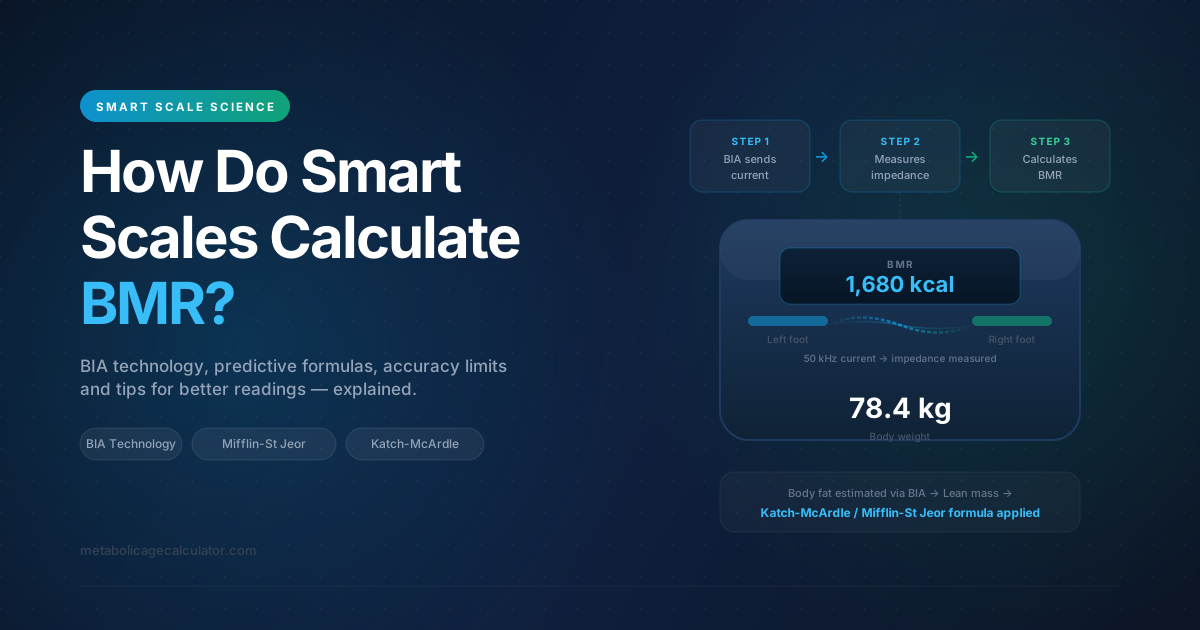
Step on a modern smart scale and within seconds it displays your BMR — the number of calories your body burns at complete rest. No lab. No fasting protocol. No clinical technician. Just a scale.
But how does a bathroom scale actually calculate your Basal Metabolic Rate? The answer involves a quiet electrical current, predictive formulas, and some important caveats you should understand before trusting that number.
This guide explains the full science behind how smart scales calculate BMR — and how to get the most accurate reading possible.
What Is BMR and Why Does It Matter?
Basal Metabolic Rate (BMR) is the number of calories your body needs to sustain basic life functions at complete rest — breathing, circulation, organ function, cell repair, and thermoregulation.
BMR typically accounts for 60–75% of your total daily calorie burn, making it the most important number in any nutrition or weight management plan.
Crucially, BMR isn’t fixed. It’s heavily influenced by your lean muscle mass. More muscle = higher BMR. More body fat = lower BMR per unit of body weight. This is exactly why smart scales don’t just weigh you — they try to measure what you’re made of.
The Core Technology: Bioelectrical Impedance Analysis (BIA)
Smart scales calculate BMR in two steps:
- Measure body composition using Bioelectrical Impedance Analysis (BIA)
- Plug those numbers into a BMR formula
BIA is the technology that makes it possible. Here’s how it works.
How BIA Works
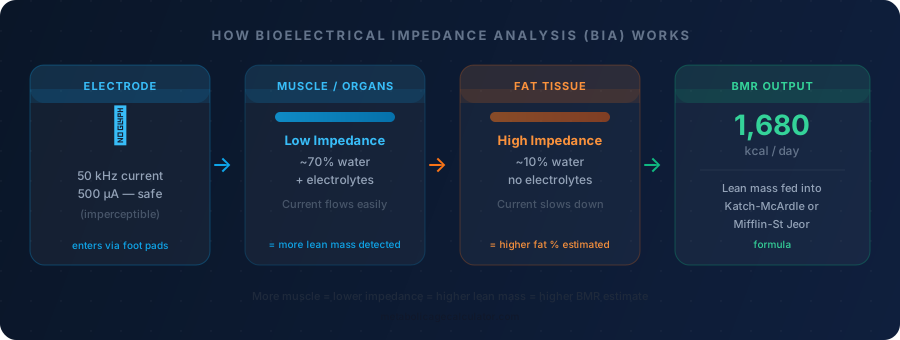
When you step on a smart scale with metal electrode pads, the scale sends a low-level electrical current (typically 50 kHz, 500 μA — completely imperceptible and safe) through your body via your feet.
The current travels through your tissues at different speeds:
- Muscle and organs contain a lot of water and electrolytes → conduct electricity easily → low impedance
- Fat tissue contains very little water → resists electrical flow → high impedance
- Bone is dense and mostly non-conductive → very high impedance
By measuring how much the current slows down (electrical impedance), the scale estimates the ratio of lean tissue to fat tissue in your body. From there, it calculates your fat-free mass (FFM) — the variable that most directly predicts BMR.
Segmental vs. Whole-Body BIA
Consumer smart scales typically use foot-to-foot BIA — current flows up one leg and down the other. This is convenient but only measures the lower body directly; the upper body is estimated.
Higher-end scales use segmental BIA (foot + hand electrodes), which measures multiple body segments separately. This produces significantly more accurate body composition data and, consequently, a more reliable BMR estimate.
The BMR Formulas Smart Scales Use
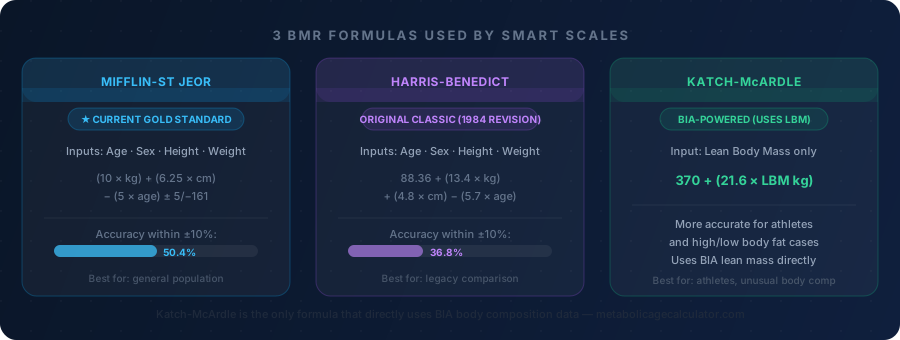
Once the scale has estimated your body composition, it calculates BMR using one of three main predictive equations. Different manufacturers use different formulas, and some allow you to switch between them.
1. Mifflin-St Jeor Equation (Most Common)
Developed in 1990, this is the current clinical gold standard. It uses age, sex, height, and weight — not body composition data.
For men:
BMR = (10 × weight in kg) + (6.25 × height in cm) − (5 × age in years) + 5
For women:
BMR = (10 × weight in kg) + (6.25 × height in cm) − (5 × age in years) − 161
A 2025 comparison of nine predictive equations found Mifflin-St Jeor was within ±10% of indirect calorimetry measurements for 50.4% of subjects — the best result of any formula tested. (Hudak et al., 2025)
Why smart scales still use this: Even without BIA data, Mifflin-St Jeor performs well across most populations. Many scales use it as the default and layer BIA data on top for refinement.
2. Harris-Benedict Equation (Revised 1984)
The original metabolic formula, revised by Roza and Shizgal. It’s widely used but less accurate than Mifflin-St Jeor — the same 2025 study found it within ±10% for only 36.8% of subjects.
For men:
BMR = 88.362 + (13.397 × weight in kg) + (4.799 × height in cm) − (5.677 × age in years)
For women:
BMR = 447.593 + (9.247 × weight in kg) + (3.098 × height in cm) − (4.330 × age in years)
Some older smart scales and fitness trackers still default to Harris-Benedict. If your scale lets you choose, Mifflin-St Jeor is the better option.
3. Katch-McArdle Formula (Body Composition-Dependent)
This is where BIA data becomes truly valuable. The Katch-McArdle formula takes lean body mass (LBM) as its primary input — the actual muscle, organ, and bone mass measured by BIA.
BMR = 370 + (21.6 × lean body mass in kg)
Because it directly accounts for your body composition rather than just weight, Katch-McArdle is theoretically more accurate for:
- Athletes with high muscle mass (Mifflin-St Jeor tends to overestimate their BMR)
- Individuals with obesity where total weight overrepresents metabolic tissue
- People with unusual muscle-to-fat ratios for their height and age
This is the formula where BIA actually earns its place. By feeding measured LBM into Katch-McArdle, smart scales produce a more personalized BMR estimate than any weight-only formula can achieve.
Accuracy: What Smart Scales Get Right and Wrong
Understanding the limitations of smart scale BMR is just as important as understanding how it works.
What Affects BIA Accuracy
BIA accuracy is highly sensitive to hydration status. Since the current travels through water, anything that shifts your body’s water distribution changes the reading:
| Factor | Effect on BIA Reading |
|---|---|
| Dehydration | Overestimates body fat % |
| Overhydration | Underestimates body fat % |
| Recent intense exercise | Shifts fluid distribution |
| Eating or drinking beforehand | Adds gut water weight |
| Menstrual cycle phase | Alters total body water |
| Time of day | Body water naturally varies |
A 2020 meta-analysis in the International Journal of Obesity found that consumer-grade foot-to-foot BIA devices had a mean error of ±3–5% for body fat percentage compared to DEXA scan reference measurements — which translates to meaningful variance in BMR estimates.
The Formula Variance Problem
Even perfect body composition data doesn’t guarantee BMR accuracy. A landmark systematic review found 26% unexplained variance in metabolic rate between individuals with identical demographics. Genetics, hormones, gut microbiome, and mitochondrial efficiency all play roles that no formula accounts for.
The honest reality: your smart scale BMR is a statistically-informed estimate, not a precision measurement. It’s accurate enough for trend tracking and general calorie planning — but not precise enough to use as an absolute number without adjustments based on real-world results.
Tips for Getting the Most Accurate Smart Scale BMR Reading
You can significantly improve consistency and accuracy by standardizing your measurement conditions.
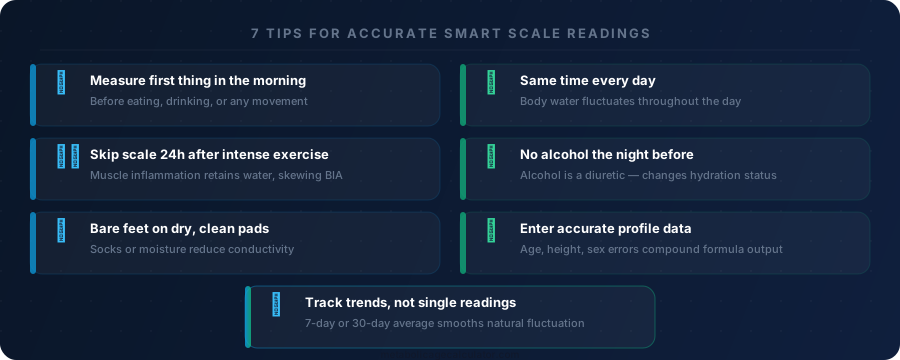
Best practice protocol:
- Measure first thing in the morning — before eating, drinking, or exercising
- Always use the scale at the same time of day — body water fluctuates throughout the day
- Stay off the scale 24 hours after intense exercise — muscle inflammation retains water and skews BIA
- Avoid alcohol the night before — alcohol is a diuretic and changes hydration status significantly
- Use bare feet on clean, dry electrode pads — any barrier reduces conductivity
- Enter accurate profile data — height, age, and sex directly affect BMR formula outputs; errors here compound immediately
- Track trends, not single readings — look at 7-day or 30-day averages to smooth out natural fluctuation
Smart Scale BMR vs. Lab-Measured BMR: How Do They Compare?
True BMR is measured by indirect calorimetry — analyzing oxygen consumption and carbon dioxide production in a controlled clinical setting after an overnight fast. This is the gold standard.
Smart scales perform reasonably well against this standard:
- Within 5% of lab measurements: achievable under ideal conditions with segmental BIA devices
- Within 10%: typical range for well-calibrated consumer scales
- ±15% or more: common when hydration conditions aren’t standardized or when body composition is extreme (very high or very low body fat)
For practical purposes — setting calorie targets, tracking metabolic changes over time, estimating metabolic age — smart scale BMR is fit for purpose. For clinical decisions (medical nutrition therapy, post-surgical recovery planning), lab measurement remains necessary.
How to Use Your Smart Scale BMR for Real Results
Once you have your BMR, the useful number is actually your TDEE (Total Daily Energy Expenditure) — BMR multiplied by an activity factor that reflects how much you move.
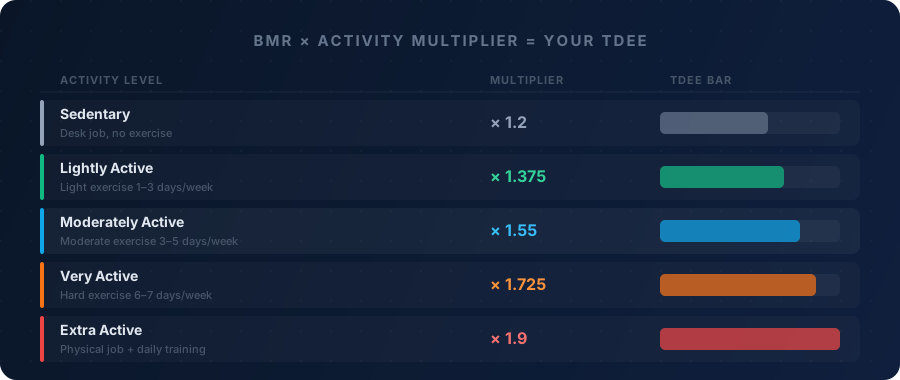
| Activity Level | Multiplier | Example |
|---|---|---|
| Sedentary (desk job, little exercise) | × 1.2 | BMR × 1.2 |
| Lightly active (1–3 days/week exercise) | × 1.375 | BMR × 1.375 |
| Moderately active (3–5 days/week) | × 1.55 | BMR × 1.55 |
| Very active (6–7 days/week hard training) | × 1.725 | BMR × 1.725 |
| Extremely active (physical job + training) | × 1.9 | BMR × 1.9 |
From TDEE, you can set calorie targets with precision:
- Fat loss: TDEE − 300 to 500 kcal/day (sustainable deficit)
- Muscle gain: TDEE + 200 to 300 kcal/day (lean bulk)
- Maintenance: eat at TDEE
Track your smart scale BMR monthly. If BMR is increasing over time, you’re building metabolically active tissue (muscle). If it’s dropping despite training, that’s a signal to review protein intake, sleep quality, or training volume.
BMR, Smart Scales, and Metabolic Age
Your BMR is also the foundation of your metabolic age — a comparison of your actual BMR against the average BMR of people at your chronological age.
A BMR higher than age-average = metabolic age younger than your real age. A BMR lower than age-average = metabolic age older than your real age.
Smart scales that display metabolic age are using your BIA-estimated BMR to make this comparison. The accuracy of your metabolic age reading depends entirely on the accuracy of your BMR estimate — which is why measurement conditions matter so much.
Use our Metabolic Age Calculator to calculate your metabolic age using the Mifflin-St Jeor formula, and compare it against the same benchmarks your smart scale uses.
Frequently Asked Questions
Do all smart scales use BIA?
Most consumer smart scales use BIA. A small number use bioelectrical impedance spectroscopy (BIS), which uses multiple frequencies for better accuracy, but these are typically clinical-grade devices. Basic digital scales with no body composition feature don’t use BIA at all — they display weight only and use Mifflin-St Jeor with default assumptions.
Why does my BMR change from day to day on the same scale?
BIA readings fluctuate with hydration. A 1–2% change in body water can shift your apparent body fat percentage by 1–3%, which changes the LBM input and shifts BMR estimates accordingly. This is normal. The solution is to measure under consistent conditions and track the trend, not individual readings.
Is a smart scale BMR accurate enough for weight loss?
Yes — as a starting point. Use your smart scale BMR to calculate a calorie target, follow it for 3–4 weeks, then adjust based on actual results. Your real-world rate of weight change tells you more about your true metabolic rate than any formula.
Which smart scale brands give the most accurate BMR?
Brands using multi-frequency segmental BIA (Withings Body Comp, Tanita RD-953, InBody H20B) consistently outperform basic foot-to-foot BIA scales. They’re more expensive but produce results within 3–5% of DEXA reference measurements under controlled conditions.
The Bottom Line
Smart scales calculate BMR by combining two technologies: BIA to estimate lean body mass, and predictive formulas (Mifflin-St Jeor, Harris-Benedict, or Katch-McArdle) to convert that composition data into a calorie estimate.
The result is a useful, actionable number — not a lab-precise measurement. Standardize your measurement conditions, track trends over time, and use your BMR as a starting point that you refine through real-world results.
For a deeper dive into how BMR is used in metabolic age calculations, read our guide on What Is Metabolic Age and see how your BMR compares against age-group averages.