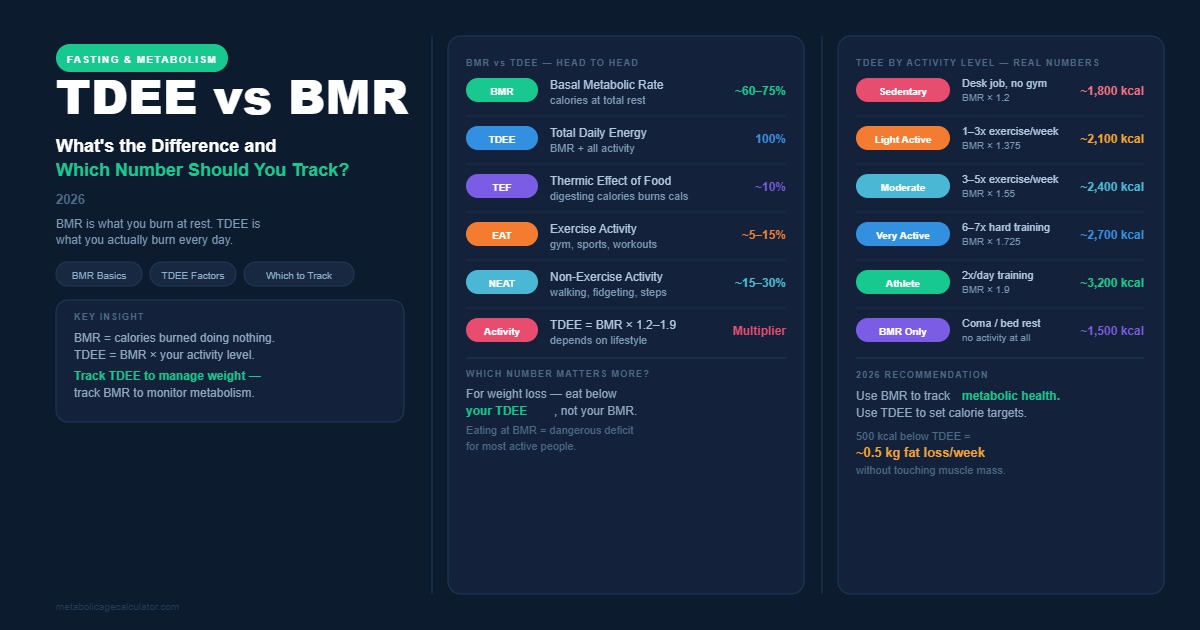
TDEE vs BMR is the most common source of confusion in calorie tracking. BMR (Basal Metabolic Rate) is the calories your body burns at complete rest; TDEE (Total Daily Energy Expenditure) is all calories you burn in a day, including activity.
Track TDEE for every diet and fitness goal. BMR is a component of TDEE not a calorie target. Eating at your BMR creates an extreme deficit because BMR excludes every calorie you burn outside of basic organ function.
This guide defines both numbers precisely, shows you how each is calculated, and tells you exactly which to use for weight loss, muscle gain, and metabolic health. Use the free metabolic age calculator to get your BMR, TDEE, and metabolic age in under 60 seconds.
What Is BMR and What Does the Number Actually Mean?
BMR is the number of calories your body burns in 24 hours at complete rest no movement, no digestion, no activity. BMR covers only the energy your body needs to maintain organ function: breathing, circulation, cell repair, brain activity, and temperature regulation.
BMR accounts for 50–70% of total daily calorie burn for most adults. The exact percentage falls as activity level rises.
How the Mifflin-St Jeor Equation Calculates BMR
To calculate BMR, use the Mifflin-St Jeor equation the current clinical gold standard for predictive accuracy. A 2025 study comparing 9 BMR formulas found Mifflin-St Jeor fell within ±10% of indirect calorimetry for 50.4% of subjects the best result of any formula tested.
Male BMR: (10 × weight in kg) + (6.25 × height in cm) − (5 × age) + 5
Female BMR: (10 × weight in kg) + (6.25 × height in cm) − (5 × age) − 161
Example: A 35-year-old male at 80 kg (176 lbs), 178 cm (5 feet 10 inches): BMR = (10 × 80) + (6.25 × 178) − (5 × 35) + 5 = 1,942 kcal per day.
The Harris-Benedict formula is the older alternative. The same 2025 study found Harris-Benedict fell within ±10% for only 36.8% of subjects making Mifflin-St Jeor the better choice for most adults.
What BMR Does Not Include
BMR excludes 4 calorie categories: digestion, daily movement (NEAT), intentional exercise (EAT), and adaptive thermogenesis. Every calorie burned outside of pure organ function at rest falls outside BMR.
This is why eating at your BMR is a mistake for weight loss. A 35-year-old at 1,942 kcal BMR actually burns 2,600–2,900 kcal per day once activity is added. Eating 1,942 kcal creates a 600–950 kcal daily deficit large enough to cause muscle loss and metabolic slowdown within weeks.
What Is TDEE and Why TDEE Is the Number You Actually Need?
TDEE is the total calories you burn every day across all activity types. TDEE = BMR + NEAT + EAT + TEF. TDEE is your maintenance calorie number eat at TDEE and weight stays stable; eat below TDEE and you lose weight.
The 4 Components That Build Your TDEE
- BMR (50–70%): Organ function at rest. Breathing, circulation, brain activity, cell production.
- NEAT Non-Exercise Activity Thermogenesis (15–30%): Energy from all non-gym movement, walking, standing, fidgeting, and household tasks.
- EAT Exercise Activity Thermogenesis (5–15%): Calories burned during planned workouts resistance training, running, cycling.
- TEF Thermic Effect of Food (8–10%): Calories burned digesting food. Protein burns 20–35% of its own calories during digestion; carbohydrates 5–10%; fat 0–3%.
NEAT varies the most between individuals by as much as 2,000 kcal per day between the least and most active adults of the same weight. This explains why 2 people with identical BMRs can have TDEE values 500–800 kcal apart.
How to Calculate TDEE From Your BMR
To calculate TDEE from BMR, multiply your BMR by the activity multiplier that matches your lifestyle:
- Sedentary (desk job, no exercise): BMR × 1.2
- Lightly active (exercise 1–3 times/week): BMR × 1.375
- Moderately active (exercise 4–5 times/week): BMR × 1.55
- Very active (daily exercise or physical job): BMR × 1.725
- Extra active (intense exercise 6–7 times/week or twice-daily training): BMR × 1.9
Example: The same 35-year-old male at BMR 1,942 kcal, moderately active: TDEE = 1,942 × 1.55 = 3,010 kcal per day.
TDEE estimates carry a ±10–15% margin of error. Treat your calculated TDEE as a starting point, then track actual weight change over 2–3 weeks and adjust in 100–150 kcal increments.
TDEE vs BMR: Side-by-Side Comparison and When to Use Each
The table below shows the precise difference between TDEE and BMR and the correct use case for each number:
|
Metric |
What It Measures |
Use For |
Includes Activity? |
Calorie Target? |
|
BMR |
Calories burned at complete rest |
Metabolic age, baseline comparison |
No |
No never eat at BMR |
|
RMR |
Calories at relaxed rest (+10–20%) |
Lab-free BMR proxy |
Minimal |
No |
|
TDEE |
Total calories burned per day |
Weight loss, gain, maintenance |
Yes |
Yes primary target |
|
TDEE − 15–20% |
Fat loss calorie target |
Cutting / weight loss diet |
Yes |
Yes fat loss |
|
TDEE + 10–15% |
Muscle gain calorie target |
Lean bulk / muscle building |
Yes |
Yes muscle gain |
The BMR vs RMR explained guide covers the technical distinction between BMR and Resting Metabolic Rate including which formula is most accurate for metabolic age calculation.
TDEE vs BMR: Which Number Should You Track for Your Goal?
Track TDEE for all diet and physique goals. Track BMR only for metabolic age comparison and health benchmarking.
How to Use TDEE for Weight Loss
To lose weight using TDEE, subtract 15–20% from your TDEE to create a moderate calorie deficit:
- Calculate TDEE using BMR × activity multiplier (see multipliers above).
- Subtract 15–20% from TDEE: TDEE × 0.80 to 0.85 = daily weight loss target.
- Set protein at 1.6–2.2 g per kg (0.73–1.0 g per lb) of bodyweight to protect muscle mass during the deficit.
- Track actual weight weekly; adjust calorie target by 100–150 kcal every 2 weeks if progress stalls.
A 500 kcal daily deficit from TDEE produces approximately 0.5 kg (1.1 lbs) of fat loss per week for most adults. Do not cut below 1,200 kcal per day for women or 1,500 kcal per day for men these floors protect BMR from adaptive suppression.
How to Use TDEE for Muscle Gain
To gain muscle using TDEE, add 10–15% above your TDEE to create a controlled calorie surplus:
- Calculate TDEE using BMR × activity multiplier.
- Add 200–300 kcal above TDEE as a starting surplus.
- Set protein at 1.6–2.2 g per kg (0.73–1.0 g per lb) of bodyweight.
- Recheck TDEE every 4–6 weeks as bodyweight and activity levels change.
Larger surpluses above 500 kcal per day produce faster weight gain but increase the fat-to-muscle ratio of that gain. A 200–300 kcal surplus maximises muscle accrual with minimal fat accumulation for most natural athletes.
When BMR Matters More Than TDEE
BMR matters most for 2 specific use cases: metabolic age calculation and identifying metabolic health decline.
Metabolic age compares your BMR to age-group averages. A BMR lower than average for your age group signals excess body fat relative to muscle a marker of metabolic syndrome risk. Use the lower your metabolic age strategies to push your BMR back above the average for your decade.
5 Factors That Affect Both Your BMR and TDEE Simultaneously
- Muscle mass: Each kg (2.2 lbs) of skeletal muscle burns roughly 13 kcal per day at rest. Building muscle raises BMR and, by extension, TDEE.
- Age: BMR falls at approximately 1–2% per decade from age 30 due to sarcopenia. TDEE declines in parallel as BMR drops and NEAT typically decreases.
- Body weight: Heavier individuals have higher BMR because more tissue requires maintenance. A 10 kg (22 lb) weight loss reduces BMR by roughly 80–150 kcal per day.
- Hormones: Thyroid hormones (T3 and T4) regulate cellular metabolic rate directly. Hypothyroidism reduces BMR by up to 40% in severe cases; hyperthyroidism raises BMR above normal.
- Sleep: Sleep deprivation raises cortisol, breaks down muscle, and reduces BMR. Adults sleeping 5 hours versus 8 hours on identical diets lose 60% more muscle and 55% less fat, per Annals of Internal Medicine.
BMR vs RMR: The Third Number Most Calculators Get Wrong
RMR (Resting Metabolic Rate) and BMR measure similar things but under different conditions. BMR requires strict laboratory conditions: fasted state, controlled room temperature, lying completely still. RMR is measured under relaxed conditions and runs 10–20% higher than true BMR.
Most online calculators including smart scale apps from Garmin, Fitbit, and Withings actually calculate RMR, not BMR, then label the result as BMR. The practical difference for diet planning is small, but the difference matters for metabolic age calculations where population benchmarks are built on true BMR data.
For weight loss planning: use whichever number your calculator provides, multiply by the correct activity factor, and you arrive at the same TDEE target. The formula error cancels out in the multiplication step.
How Often to Recalculate Your TDEE and BMR
Recalculate both numbers every 4–6 weeks during active weight loss or muscle building phases. Recalculate every 10–15 lbs (4.5–6.8 kg) of weight change regardless of timeframe.
3 events that trigger an immediate recalculation:
Weight changes by more than 5 kg (11 lbs) in either direction.
Activity level changes significantly a new training programme, starting a physical job, or extended injury layoff.
A thyroid panel reveals hypothyroidism or hyperthyroidism diagnosis.
TDEE can vary by 200–400 kcal between people of identical body size due to genetics, NEAT differences, and gut microbiome variation. Calculated TDEE is a starting estimate let 2–3 weeks of actual weight data confirm whether the number is accurate for you.
Frequently Asked Questions: TDEE vs BMR
Should you eat at your BMR or TDEE to lose weight?
Eat at a deficit below your TDEE, not at your BMR. Eating at BMR ignores all activity calories and creates an extreme deficit that causes muscle loss and metabolic slowdown. Target TDEE minus 15–20% for sustainable fat loss.
Is TDEE always higher than BMR?
Yes. TDEE always exceeds BMR because TDEE includes BMR plus all other calorie expenditure digestion, movement, and exercise. For sedentary adults, TDEE is typically BMR × 1.2; for very active adults, TDEE can reach BMR × 1.9.
Can you increase your BMR without exercise?
Yes, but the effect is smaller. Increasing dietary protein raises BMR slightly through its 20–35% thermic effect. Correcting hypothyroidism with medication raises BMR significantly. Resistance training remains the most effective tool for raising BMR by building lean muscle mass.
How accurate are online TDEE calculators?
TDEE calculators carry a ±10–15% margin of error for most individuals. The Mifflin-St Jeor equation is the most accurate formula available. Use your calculated TDEE as a starting point and adjust by 100–150 kcal every 2 weeks based on actual weight data.
Does TDEE change if you stop exercising?
Yes. Stopping exercise reduces your EAT component immediately. A person who burns 400 kcal per session, 4 times per week, loses 1,600 kcal of weekly TDEE when training stops. Long-term inactivity also reduces NEAT and, over months, BMR through muscle loss.
Track the Right Number Starting Today
BMR reveals your metabolic baseline. TDEE tells you how many calories you actually burn. Use TDEE to set every calorie target whether cutting, bulking, or maintaining. Use BMR to measure where your metabolic health sits relative to your age group.
The free metabolic age calculator gives you BMR, TDEE, and your metabolic age in under 60 seconds no sign-up, no email required. Calculate your numbers now and start tracking the metric that actually drives your results.