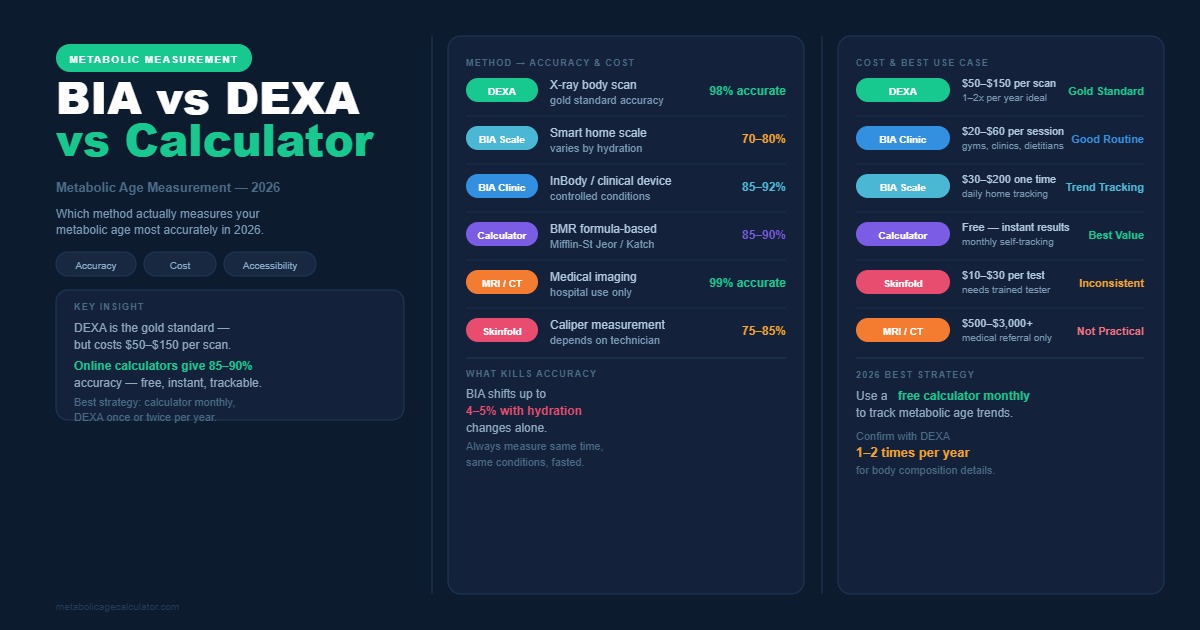
A DEXA (dual-energy X-ray absorptiometry) scan delivers the most accurate metabolic age reading. Its error margin runs just 1 to 2%. Bioelectrical Impedance Analysis (BIA) scales fall in the middle, at 8-12%. A free online calculator estimates 5-8% without body fat data. Your choice among BIA, DEXA, and online calculators depends on your budget and precision needs. Your choice also depends on how often you plan to retest. This guide compares all 3 methods using verified accuracy data, real cost figures, and 5 specific use cases. You pick the right tool the first time. Each method treats muscle and fat differently, resulting in opposite effects for athletes and older adults.
BIA vs DEXA vs Online Calculator: The Quick Answer
DEXA wins on accuracy, BIA wins on convenience, and an online calculator wins on cost and accessibility. Each method estimates a different layer of data and then converts it into an age-equivalent score.
A DEXA scan measures bone density, fat mass, and lean mass directly with low-dose X-ray technology. A BIA device sends a low electrical current through your body and estimates tissue composition based on the resulting resistance. An online calculator skips body composition and estimates Basal Metabolic Rate (BMR) from your age, weight, height, and sex.
You get the closest result to a clinical lab when you choose DEXA. You get the fastest, cheapest result when you choose an online calculator. You get a useful middle ground with a BIA smart scale, especially for tracking week-to-week trends.
Knowing which layer of data a method measures helps you interpret a confusing result. A normal BMI alongside a high metabolic age, for example, often points to low muscle mass rather than excess weight.
What Is BIA and How Accurate Is It?
BIA estimates body fat and muscle mass within an 8 to 12% margin of error when checked against lab-grade methods. Bioelectrical Impedance Analysis works by sending a tiny, painless electrical current through your feet, hands, or full body. BIA technology was first developed for clinical use in the 1980s. The technology has since moved into consumer scales from brands such as Tanita, Withings, Renpho, and Fitbit.
How BIA Estimates Your Body Fat Percentage
To estimate your body fat percentage, a BIA device measures resistance as current passes through tissue. Muscle and water conduct electricity faster than fat, so a fast current reading signals higher lean mass. The device combines this resistance value with your height, weight, age, and sex inside a proprietary formula. Brands such as Tanita, Withings, and Renpho each use a different formula. Results vary by 3 to 5% between devices. Full-body scales with hand grips, such as the InBody and Tanita DC-430, read upper- and lower-body segments separately. Segmented data produces a more detailed muscle map.
4 Factors That Skew BIA Readings
Even a well-calibrated BIA scale produces different numbers across a single day for these reasons:
- Hydration level: dehydration can inflate fat estimates by up to 10%
- Time of day: morning readings before food or exercise produce the most consistent results
- Electrode placement: uneven foot positioning on the scale plate introduces measurement error
- Device mode: athletes need athlete mode, since the standard algorithm misreads high muscle mass as water weight
What Is a DEXA Scan and Why Is It the Gold Standard?
A DEXA scan is the gold standard for body composition testing. The scan measures fat, muscle, and bone directly with dual-energy X-ray absorptiometry, rather than estimating tissue from electrical resistance.
Radiologists and sports scientists rely on DEXA for its tissue-level detail. The X-ray method separates 3 distinct tissue types instead of estimating one fat percentage. This level of detail explains why researchers use DEXA as the reference standard. Studies rely on DEXA data to validate BIA scales and online calculators.
How a DEXA Scan Measures Body Composition
To measure body composition with DEXA, a low-dose X-ray beam passes through your body at 2 distinct energy levels. Bone, fat, and lean tissue absorb each energy level differently, and the scanner calculates exact mass for each tissue type. Total scan time including setup runs 15 to 20 minutes. The actual X-ray exposure lasts under 10 minutes. The scan exposes you to less radiation than a single cross-country flight.
DEXA Scan Cost and Availability
A single DEXA scan costs $40 to $150 (roughly £32 to £119) in most US metro areas. Your exact price depends on your city and provider. Providers such as BodySpec and DexaFit operate fixed scan locations or mobile vans in major metro areas. Health insurance rarely covers a DEXA body composition scan. Insurers classify the scan as elective unless a doctor orders the scan for bone density screening. Most people without a medical referral cannot access a hospital DEXA machine. Hospitals reserve scan time for bone density diagnostics instead. Many gyms and sports performance centers now host monthly DEXA scan days through partnerships with mobile providers.
How Accurate Is an Online Metabolic Age Calculator?
An online metabolic age calculator is accurate within 5 to 8% of lab-measured values. This accuracy holds when you use a validated formula such as Mifflin-St Jeor. These calculators rely on decades-old population datasets, so results stay consistent across sites that use the same formula.
How to Calculate Metabolic Age With an Online Tool
To calculate metabolic age with an online tool, enter your age, sex, height, and weight. Then add your activity level into a Mifflin-St Jeor or Katch-McArdle calculator. The calculator converts your inputs into an estimated BMR. It then compares that number against population averages for your age group.
The age group with the closest matching average BMR becomes your metabolic age. Take a 35-year-old woman who weighs 150 lb (68 kg) and stands 5 feet 6 inches (168 cm) tall. Her Mifflin-St Jeor formula returns a BMR near 1,400 calories per day. The calculator then matches that number against the closest age-group average. Adding your body fat percentage narrows the margin of error. The calculator can then switch to the more precise Katch-McArdle formula.
BIA vs DEXA vs Online Calculator: Side-by-Side Accuracy Comparison
DEXA scans land within 1 to 2% of clinical results. BIA scales land within 8 to 12%, and online calculators land within 5 to 8%.
- Online calculator: 5 to 8% margin of error, $0 cost, results in under 60 seconds
- BIA smart scale: 8 to 12% margin of error, $30 to $300 cost, results in under 30 seconds
- DEXA scan: 1 to 2% margin of error, $40 to $150 (£32 to £119) per scan, results in 24 to 48 hours
These figures come from validation studies that compared each method against indirect calorimetry in controlled lab settings. Nutrition research has shown Katch-McArdle-based calculators carry a mean bias near 1.5% when body fat data is accurate. Standard Mifflin-St Jeor estimates without body fat data show wider variation between individuals.
Cost and convenience move in the opposite direction from accuracy. An online calculator requires zero equipment and zero dollars, while a DEXA scan requires an appointment and a fee. None of the 3 methods matches a clinical Resting Metabolic Rate (RMR) test using indirect calorimetry. Indirect calorimetry measures oxygen and carbon dioxide exchange directly and costs $200 to $400 per session.
Which Metabolic Age Test Should You Choose?
Choose an online calculator for a free baseline and a BIA scale for weekly tracking. Choose a DEXA scan for a one-time accuracy check.
Best Test for Tracking Progress Over Time
To track progress over time, use the same BIA smart scale every week under identical conditions. Consistency matters more than absolute accuracy when you measure trends. One device applies the same formula and bias every time. Retest every 7 days at the same time of morning for the cleanest trend line.
Best Test for One-Time Clinical-Grade Accuracy
For one-time clinical-grade accuracy, book a DEXA scan twice a year. Two scans 6 months apart reveal real changes in lean mass, fat mass, and bone density. Pair your DEXA scan with our free body fat calculator between visits to estimate body fat percentage at no cost.
Best Test for a Tight Budget
On a tight budget, rely on a free online calculator and skip paid equipment entirely. Recalculate every 2 weeks using the same formula and the same input habits. Weigh yourself at the same time each morning for consistency. Add a one-time DEXA scan later if your results plateau for more than 90 days.
How to Get More Accurate Results From Any Method
You get more accurate results from any method by controlling 3 variables: hydration, timing, and consistency. Skipping these 3 variables explains most of the conflicting results people report when they switch between testing methods.
How to Prepare for a BIA or Smart Scale Reading
To prepare for a BIA or smart scale reading, weigh yourself in the morning after using the restroom. Do this before eating or drinking. Avoid exercise for at least 12 hours before your reading, since muscle fatigue and sweat change hydration status. Stand barefoot, centered on the plate, with even weight on both feet. Remove heavy jewelry and bulky clothing first, since added weight changes the resistance calculation slightly. Our guide on smart scales calculate BMR breaks down the exact formula behind your scale's number.
Quick-Reference: Metabolic Age Testing Tasks
Use this schedule to combine all 3 methods without overtesting:
|
Task |
Timing |
Method |
Difficulty |
|
Get a baseline reading |
Day 1, morning, fasted |
Online calculator |
Easy |
|
Confirm body composition |
Week 1 |
BIA smart scale |
Easy |
|
Get lab-grade accuracy |
Within 30 days |
DEXA scan |
Moderate |
|
Track muscle gain |
Every 7 days |
BIA smart scale |
Easy |
|
Validate major changes |
Every 6 months |
DEXA scan |
Moderate |
5 Common Mistakes That Skew Metabolic Age Results
The 5 most common mistakes are testing after exercise, comparing results across devices, and skipping body fat inputs. Two more mistakes are testing at inconsistent times and ignoring hydration status.
- Testing after exercise: elevated heart rate and sweat loss skew BIA resistance readings for up to 2 hours
- Comparing results across different devices: each BIA brand uses a proprietary formula, so switching devices breaks your trend line
- Skipping body fat inputs: an online calculator defaults to a less precise formula without this number
- Testing at inconsistent times: BMR estimates shift by 2 to 3% between morning and evening readings
- Ignoring hydration status: water weight swings of 2 to 4 lb (1 to 2 kg) change BIA results significantly
BIA vs DEXA vs Online Calculator: Which One Do Trainers and Doctors Use?
Personal trainers favor BIA scales for client check-ins, while doctors and sports scientists favor DEXA for diagnostic accuracy.
A BIA scale fits into a 5-minute gym session and costs nothing per use after the initial purchase. Trainers track BIA trends weekly to show clients visible progress between DEXA visits.
Doctors order DEXA scans primarily for bone density screening in adults over 50. Body composition data comes as a secondary benefit. Sports scientists at university labs use DEXA to validate new fitness wearables and online formulas before publication. Neither group treats an online calculator as a clinical tool. Most still recommend a calculator as a free starting point for general awareness.
Frequently Asked Questions About BIA vs DEXA vs Online Calculator Testing
Is a DEXA scan worth the cost compared to a free online calculator?
Yes. A DEXA scan is worth the cost if you want lean mass, fat mass, and bone density data. That data stays accurate within 1 to 2%. A free online calculator only requires height, weight, age, and sex, with no equipment. Its margin of error runs 5 to 8%. Choose DEXA when you need a baseline before a major training program or medical evaluation.
Can a BIA smart scale replace a DEXA scan?
No. A BIA smart scale cannot replace a DEXA scan for clinical-grade accuracy. Its margin of error runs 8 to 12%, compared to DEXA's 1 to 2%. A BIA scale still works well for tracking weekly trends at a fraction of the cost.
How often should you retest your metabolic age?
Retest every 7 to 14 days with a BIA scale or online calculator. Retest every 6 months with a DEXA scan. Muscle mass and BMR change slowly, so retesting more often than these windows adds noise rather than signal. Testing daily mostly captures water weight fluctuation, not real metabolic change.
Does body fat percentage improve online calculator accuracy?
Yes. Adding your body fat percentage lets an online calculator switch formulas. The calculator moves from Mifflin-St Jeor to the more precise Katch-McArdle formula. Katch-McArdle uses lean body mass directly, which lowers the mean bias to about 1.5% in published validation studies.
Is metabolic age the same as biological age?
No. Metabolic age reflects how efficiently your body burns calories at rest, compared to others your chronological age. Biological age reflects cellular aging markers such as DNA methylation, telomere length, and organ function. Both can differ from your real age, but they measure different things entirely.
Your Next Step: Calculate Your Metabolic Age Now
BIA vs DEXA vs online calculator comes down to one tradeoff: precision against price. A DEXA scan gives you the closest result to a lab. A BIA scale gives you fast weekly tracking. An online calculator gives you a free starting point in under 60 seconds. Most people get the best results by combining all 3 methods. Use a free calculator for daily decisions and a BIA scale for weekly trends.
Add a DEXA scan twice a year for ground truth. Calculate your starting number now, then compare your number against your BMR vs RMR results. This comparison shows exactly which calorie number drives your metabolic age. Whichever method you start with, write down your number and the date. A single reading means little without a future comparison point.