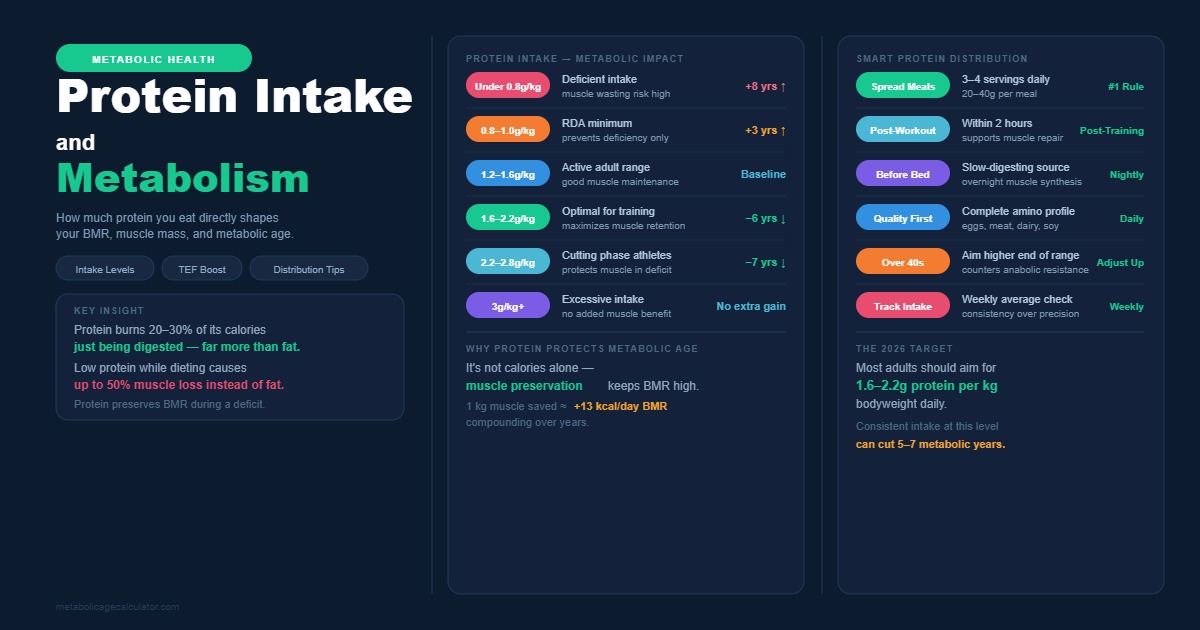
Most healthy adults need 1.6 to 2.2 grams (0.73 to 1 gram per pound) of protein per kilogram of body weight daily to support metabolism. Protein intake and metabolism connect directly through muscle tissue, since muscle burns more calories at rest than fat. Your age, activity level, and current goal all shift that number up or down. This guide gives you exact protein targets by goal, age, and activity level for 2026, plus the science behind each figure.
How Much Protein Do You Need for Metabolism?
Your metabolism responds best to a protein intake between 1.6 and 2.2 grams per kilogram of body weight each day. That equals 0.73 to 1 gram per pound. A 70 kilogram (154 pound) adult needs 112 to 154 grams daily. That amount supports muscle repair and calorie burning.
This range comes from 3 separate bodies of research: sports nutrition trials, geriatric muscle studies, and metabolic rate experiments. Each source points above the outdated 0.8 gram per kilogram minimum.
The 0.8 gram per kilogram Recommended Dietary Allowance (RDA) only prevents deficiency in sedentary adults. It does not optimize your Basal Metabolic Rate (BMR) or protect muscle during weight loss. Researchers set the RDA using nitrogen balance studies from decades ago. Those studies came before scientists linked protein intake to metabolic rate and body composition.
You raise your metabolic efficiency by eating enough protein to match your body weight, your training volume, and your age. Three factors override the standard RDA: an active lifestyle, a calorie deficit, and an age above 60 years.
Body composition matters more than the number on the scale. Two adults at the same weight can need different protein amounts if one carries more lean muscle mass than the other. A muscular 80 kilogram (176 pound) adult needs more protein than a higher body fat adult at the same weight. Muscle tissue requires more amino acids for daily repair.
How Does Protein Intake Affect Your Basal Metabolic Rate?
Protein raises your Basal Metabolic Rate (BMR) more than carbohydrates or fat. Digestion burns 20 to 30 percent of protein calories alone.
This process is called the Thermic Effect of Food (TEF). Carbohydrates use 5 to 10 percent of their calories for digestion. Fat uses 0 to 3 percent of its calories the same way.
A 2,000 calorie diet with 30 percent protein burns roughly 120 to 180 calories through digestion alone. A low protein diet built mainly from carbohydrates and fat burns fewer than 60 calories the same way. That daily gap, repeated over a year, adds up to a measurable difference in total energy expenditure.
Muscle tissue adds a second metabolic boost. Each kilogram (2.2 pounds) of muscle burns approximately 13 kilocalories daily at rest. The same amount of fat tissue burns only 4.5 kilocalories. Ten extra kilograms (22 pounds) of muscle can raise your resting burn by roughly 130 kilocalories per day.
Adequate protein intake preserves this muscle during a calorie deficit. Insufficient protein forces your body to break down muscle for fuel, which lowers your BMR and raises your metabolic age. Losing muscle also reduces your Total Daily Energy Expenditure (TDEE), making future fat loss progressively harder.
Your BMR typically accounts for 60 to 75 percent of your Total Daily Energy Expenditure (TDEE). That makes it the single largest factor in your daily calorie needs. Protecting muscle mass through adequate protein intake protects that largest share of your daily burn.
You can check our BMR versus RMR guide to see which number matters for your goal. People often use the two terms interchangeably, but they measure different things.
How Many Grams of Protein Should You Eat Based on Your Goal?
Your protein target shifts depending on whether you want to lose fat, build muscle, or maintain your current weight. Body weight alone is not enough information; your training volume and calorie balance both change the ideal number.
Protein for Weight Loss
Target 1.6 to 2.2 grams per kilogram of body weight during a calorie deficit. In pounds, that is 0.73 to 1 gram per pound. This range preserves lean muscle mass while you lose fat.
A controlled comparison found dieters eating 2.3 grams per kilogram lost 0.3 kilograms (0.66 pounds) of muscle. Dieters eating 1.0 gram per kilogram lost 1.6 kilograms (3.5 pounds) of muscle over the same period. Both groups lost similar amounts of total body fat.
Named protein sources for weight loss include chicken breast, cottage cheese, and white fish. Each delivers high protein with low calories per serving. Pairing these foods with vegetables extends fullness between meals.
Protein for Muscle Gain
Target 2.0 to 2.4 grams per kilogram of body weight when building muscle. In pounds, that is 0.9 to 1.1 grams per pound. Research shows no added benefit above 2.4 grams per kilogram.
Named protein sources for muscle gain include eggs, lean beef, and whey protein isolate. Each supplies complete amino acid profiles that support muscle protein synthesis (MPS). Combining resistance training with this intake range produces the fastest strength gains.
Protein for Sedentary Maintenance
Target 1.2 to 1.6 grams per kilogram if you are not training and want to maintain your current weight. In pounds, that is 0.55 to 0.73 grams per pound. This range exceeds the RDA while supporting normal muscle turnover.
How Does Age Change Your Protein Requirements?
Adults over 60 need 25 to 30 percent more protein per meal than adults under 40. The reason is anabolic resistance.
Anabolic resistance describes a blunted muscle response to protein as you age. Your muscles need a larger protein dose to trigger the same rate of muscle protein synthesis. A younger adult reaches that rate with less.
Protein Needs for Adults Under 40
Adults under 40 typically reach full muscle protein synthesis with 20 to 25 grams of protein per meal. Named sources like Greek yogurt, tofu, and grilled chicken each supply this amount in a single serving. Younger adults also recover protein balance faster after a low protein meal. Their muscle tissue responds more efficiently to smaller doses.
Protein Needs for Adults Over 60
Adults over 60 need 25 to 30 grams of protein per meal, spread across 3 meals daily. This distribution counters anabolic resistance and reduces sarcopenia risk. Sarcopenia is the progressive loss of skeletal muscle mass and strength that accelerates after age 50.
UK researchers studying 256 older adults found that most fell below this per-meal threshold, particularly at breakfast. Those consistently under the threshold showed measurably lower lean muscle mass over the study period.
Declining hormone levels compound this effect. Lower growth hormone and testosterone output after age 50 reduces the natural drive toward muscle repair. This shift makes dietary protein a more important lever than it was at age 30.
Protein Needs During Pregnancy and Breastfeeding
Pregnant and breastfeeding women need at least 1.7 grams per kilogram (0.77 grams per pound) daily. That target sits higher than the standard adult range. This elevated need supports fetal growth and milk production, both of which draw heavily on maternal amino acid stores.
How to Calculate Your Daily Protein Target
To calculate your daily protein target, start with your body weight in kilograms, then multiply by your goal-specific gram range.
- Convert your body weight to kilograms. Divide pounds by 2.2 to get kilograms.
- Choose your gram range based on your goal: 1.2 to 1.6 for maintenance, 1.6 to 2.2 for fat loss, 2.0 to 2.4 for muscle gain.
- Multiply your body weight in kilograms by the low and high end of your range.
- Divide your daily total across 3 to 4 meals for steady muscle protein synthesis.
Example: A 65 kilogram (143 pound) woman aims for muscle gain. She multiplies 65 by 2.0 and 2.4, landing on a target between 130 and 156 grams daily.
If you want your protein target calculated alongside your carbohydrate and fat needs, try the macro calculator tool on this site. It builds a full daily plan from your calorie target and body weight. Recalculate every 5 to 10 pounds (2 to 5 kilograms) of weight change to keep your target accurate.
Protein Intake Quick-Reference Table by Goal
|
Goal |
Protein Target (g/kg) |
Meal Timing |
Tracking Method |
Difficulty |
|
Fat loss |
1.6-2.2 |
3-4 meals, 25-40g each |
Food scale + app |
Moderate |
|
Muscle gain |
2.0-2.4 |
4 meals, post-workout priority |
Food scale + app |
Moderate |
|
Maintenance |
1.2-1.6 |
3 meals, flexible timing |
App tracking only |
Easy |
|
Adults over 60 |
1.2-1.5 (25-30g/meal) |
3 meals, even distribution |
Food scale + app |
Moderate |
What Foods Deliver the Most Protein Per Serving?
High protein foods let you hit your daily target without excess calories. Named sources you can build meals around include chicken breast, Greek yogurt, cottage cheese, lentils, tofu, eggs, and whey protein isolate.
A 100 gram (3.5 ounce) serving of chicken breast delivers 31 grams of protein at roughly 165 calories. The same weight of cottage cheese delivers 11 grams, while cooked lentils deliver 9 grams per 100 grams.
Whey protein isolate delivers 25 grams of protein per 30 gram (1 ounce) scoop. That makes it useful for hitting your target quickly after training. Two large eggs supply 12 grams of protein along with essential vitamins your body needs for muscle repair.
Plant-based eaters can combine lentils, tofu, and quinoa across a day to reach complete amino acid coverage. No single plant source contains every essential amino acid (EAA) in ideal ratios.
Reading nutrition labels helps you compare protein density accurately. A food with 20 grams of protein per 300 calorie serving offers a lower protein-to-calorie ratio. A food with 20 grams of protein per 120 calorie serving offers a higher ratio, even though both list the same protein amount.
How to Time Your Protein Intake for Better Metabolic Results
To time your protein intake for better metabolic results, spread your total across 3 to 4 meals rather than 1 or 2 large servings.
Your body metabolizes protein more efficiently in doses of 15 to 30 grams. Studies show intakes above 40 grams in a single sitting add no measurable extra benefit to muscle protein synthesis.
Eating protein within 2 hours after resistance training supports muscle repair. Total daily protein intake matters more than exact timing. A pre-sleep serving of 30 to 40 grams, such as cottage cheese or casein protein, may extend overnight muscle repair.
Older adults benefit most from strict meal distribution. Anabolic resistance limits how much protein your body can use in a single sitting. Skipping breakfast protein and loading dinner with a large serving wastes some of that intake.
What Mistakes Should You Avoid When Increasing Protein Intake?
- Avoid concentrating your entire daily target into 1 meal. Your body cannot use more than 40 grams at once for muscle protein synthesis.
- Avoid replacing all carbohydrates with protein. Carbohydrates fuel high-intensity training and replenish glycogen stores your muscles need for the next session.
- Avoid ignoring hydration as you raise protein intake. Protein metabolism increases your kidneys' filtration workload and water needs.
- Avoid guessing your target instead of calculating it from your actual body weight. A flat 100 gram daily target under-serves a 100 kilogram (220 pound) adult. That same target over-serves a 50 kilogram (110 pound) adult.
- Avoid stopping resistance training while increasing protein intake. Protein alone builds little new muscle without a mechanical training stimulus to trigger muscle protein synthesis.
- What Happens If You Eat Too Little or Too Much Protein?
Eating below 0.8 grams per kilogram daily causes progressive muscle loss and a slower Basal Metabolic Rate. Over time, this pattern raises your metabolic age.
Low protein intake also reduces satiety. That effect increases the odds of overeating carbohydrates and fat throughout the day. This pattern commonly appears in older adults who eat smaller food portions at each meal.
Very high protein intake, above 3.5 grams per kilogram daily, shows no added metabolic benefit in healthy adults with normal kidney function. Extra protein calories beyond your needs get stored as fat. That outcome matches what happens with excess carbohydrates or fat.
You can review the full strategy in our guide on how to lower your metabolic age. It helps if your current habits are pushing your number in the wrong direction. That guide pairs protein targets with sleep, training, and stress recommendations for a complete plan.
Frequently Asked Questions
Is 100 grams of protein a day enough for metabolism?
Yes, for a smaller adult under 60 kilograms (132 pounds) at maintenance. A larger or more active adult needs more protein to reach the 1.6 to 2.2 gram per kilogram range.
Does eating more protein permanently raise your metabolism?
No. Protein temporarily raises calorie burn through digestion and supports muscle mass. It does not permanently change your resting metabolic rate without added muscle mass.
Can eating too much protein slow your metabolism?
No. Research shows no metabolic slowdown from high protein intake in healthy adults. Extra calories beyond your needs still contribute to weight gain over time.
How much protein per meal maximizes muscle protein synthesis?
25 to 40 grams per meal maximizes muscle protein synthesis for most adults. Older adults need the higher end of that range to overcome anabolic resistance.
Does protein intake change your metabolic age?
Yes. Adequate protein intake preserves muscle mass, which keeps your Basal Metabolic Rate higher and can lower your calculated metabolic age within 90 days of consistent habits.
Hitting your protein target is one of the fastest ways to protect your Basal Metabolic Rate. It also helps improve your metabolic age in 2026. Start by calculating your current numbers with the body fat calculator on Metabolic Age Calculator. Then use your results to set a protein target that matches your goal.