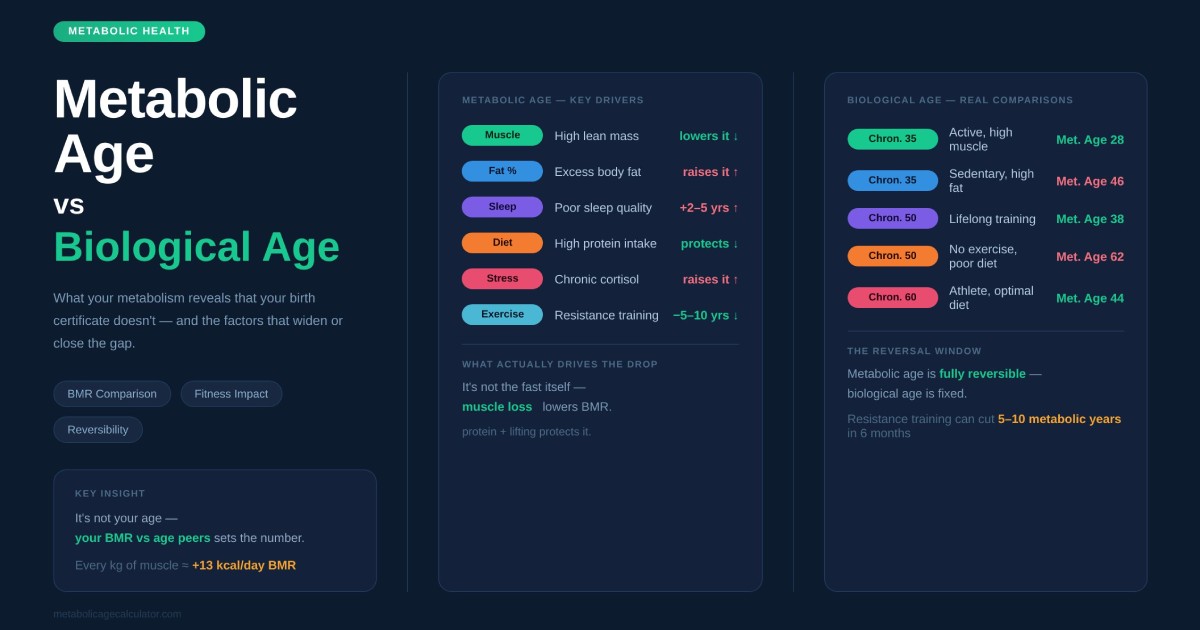
Metabolic age compares your Basal Metabolic Rate (BMR) to the average BMR for your chronological age group. Biological age measures cellular aging through DNA methylation, telomere length, and organ function instead.
Both numbers claim to reveal your true age. Metabolic age and biological age track entirely separate biological processes. Metabolic age relies on simple body data: your weight, height, age, and sex. Biological age is determined by molecular data from a blood or saliva sample.
You can calculate metabolic age for free in under 60 seconds. Biological age testing requires a lab kit and a 2- to 4-week wait for results. This guide breaks down the metabolic age vs biological age comparison, shows the formulas behind each number, and helps you pick the right test for your goal.
Knowing the difference saves you money. Many people buy expensive lab tests when a free calculator already answers their question.
What Is the Difference Between Metabolic Age and Biological Age?
Metabolic age reflects how efficiently you burn calories at rest. Biological age reflects how aged your cells and organs actually are.
Metabolic age starts with your BMR, the number of calories your body needs to breathe, circulate blood, and maintain its temperature. A calculator compares your BMR against population averages across 6 age brackets: the 20s, 30s, 40s, 50s, 60s, and 70-plus groups.
Biological age starts with epigenetic markers, primarily DNA methylation patterns. These chemical tags attach to your DNA and shift as your cells age. Researchers analyze hundreds of thousands of methylation sites across your genome to estimate organ-level aging.
The 2 numbers rarely match. A 45-year-old man with low muscle mass might post a metabolic age of 52 alongside a biological age of 41. Cardiovascular health, immune function, and inflammation markers shape biological age in ways a BMR formula cannot capture.
This combination matters for real decisions. A favorable metabolic age, paired with elevated inflammatory markers, still raises cardiovascular risk. Checking both numbers catches risks that either metric alone would miss.
Picture a 38-year-old runner who logs a metabolic age of 29, thanks to high muscle mass and regular cardio. The same runner can show a biological age of 44 if chronic stress or poor sleep accelerates DNA methylation. One fitness routine improved a single marker without touching the other.
Use metabolic age vs biological age data together, not interchangeably, for the clearest picture of your health.
What Is Metabolic Age and How Do You Calculate It?
Metabolic age is the age group whose average BMR matches your own, based on your weight, height, age, and sex.
Three formulas estimate BMR: the Mifflin-St Jeor equation, the Harris-Benedict equation, and the Katch-McArdle formula. The Mifflin-St Jeor equation delivers the highest accuracy for most adults, within 5% accuracy.
The Harris-Benedict equation predates the Mifflin-St Jeor equation by 65 years, having been first published in 1919 and revised in 1984. Average body composition has shifted since 1919, which explains why the older formula now overestimates BMR by roughly 5% for many adults.
How to Calculate Metabolic Age Step by Step
To calculate metabolic age, first enter your weight, height, age, and sex into the Mifflin-St Jeor formula. For men, BMR equals (10 x weight in kg) + (6.25 x height in cm) - (5 x age) + 5. For women, BMR equals (10 x weight in kg) + (6.25 x height in cm) - (5 x age) - 161.
Compare your BMR result against age-group averages next. Consider a 154-lb (70-kg) woman who stands 5 feet 5 inches (165 cm) tall and is 42 years old. Her BMR of 1,420 calories falls within the 50-59 average range, placing her metabolic age roughly 10 years above her real age.
Which BMR Formula Is Most Accurate?
The Katch-McArdle formula delivers the most accurate result for lean, athletic individuals because it factors in lean body mass rather than total weight. This formula requires your body fat percentage as an input.
Find your body fat percentage with a free body fat calculator before running the Katch-McArdle numbers. Athletes and bodybuilders benefit most from this formula, since standard equations can underestimate their BMR by 5% to 10%.
What Is Biological Age and How Is It Measured?
Biological age estimates the true age of your cells using molecular markers, separate from your birth date.
Two people born in the same year can have biological ages that differ by 15 years. Genetics, diet, sleep quality, stress levels, and toxin exposure all shift the molecular clock at different speeds.
Researchers built the first widely used epigenetic clock, called the Horvath clock, in 2013. The Horvath clock used methylation data from 8,000 tissue samples. Newer clocks now target specific organ systems rather than a single whole-body number.
Saliva-based tests and blood-based tests both measure DNA methylation, but accuracy differs. Blood samples capture signals directly from your liver, kidneys, and immune system. Saliva samples capture signals from cheek cells alone, missing organ-specific detail that blood provides.
What Are the Hallmarks of Biological Aging?
Scientists track 11 hallmarks of aging, including genomic instability, telomere attrition, epigenetic alterations, and mitochondrial dysfunction. Cellular senescence, stem cell exhaustion, and chronic inflammation round out the remaining hallmarks. Each hallmark represents a specific type of cellular damage that accumulates over decades.
How Accurate Are Epigenetic Age Tests?
Epigenetic clocks predict chronological age within 2 to 4 years in published validation studies. Blood-based tests outperform cheek-swab tests because blood carries cellular signals from every organ system instead of one tissue type.
Results still vary between testing companies, because no single epigenetic clock has become the industry standard. A 2024 result from one lab can differ from a 2026 result from another lab by several years.
How Does Metabolic Age Compare to Chronological Age?
Chronological age is fixed and counts the years since your birth. Metabolic age varies with muscle mass, activity level, and diet.
A 50-year-old man who lifts weights 4 times a week can post a metabolic age of 38. A sedentary 28-year-old with low muscle mass can post a metabolic age of 41 during the same week.
This 13-year spread between the 2 examples proves a simple point: metabolic age moves independently of the calendar. Chronological age never changes. Metabolic age responds to your habits within 90 days.
The same pattern holds for women. A 35-year-old new mother with consistent strength training can post a metabolic age of 30. A 35-year-old office worker with a sedentary routine can have a metabolic age of 39, falling within the same bracket.
Track both numbers side by side, every few months. Chronological age tells you how long you have lived. Metabolic age tells you how well your body performs relative to your peers right now.
Which Test Should You Use: Metabolic Age or Biological Age?
Start with a free metabolic age calculator. Upgrade to biological age testing only if you want organ-level detail.
The table below compares 5 common testing methods in terms of cost, time, and accuracy.
|
Method |
Cost |
Time to Result |
Accuracy |
|
Free Online Calculator |
$0 |
Under 60 sec |
+/-5-8% |
|
Smart Scale (BIA) |
$30-$300 |
1 min |
+/-8-12% |
|
DEXA Scan |
$40-$150 per scan |
15 min |
+/-1-2% |
|
Lab Calorimetry |
$200-$400 |
30-60 min |
+/-1% |
|
Epigenetic Blood Test |
$100-$500 |
2-4 weeks |
+/-2-4 yrs (chrono. age) |
When to Use a Free Metabolic Age Calculator
Use a metabolic age calculator if you track weight loss progress, plan daily calorie intake, or want a quick fitness benchmark. The test takes under 60 seconds and skips the blood draw entirely. Enter your stats once a month and watch the trend line, rather than chasing a single number.
When to Consider a Biological Age Test
Consider biological age testing if you manage a chronic condition, plan a long-term longevity protocol, or want organ-specific data points. Budget $100 to $500 and plan to wait 2 to 4 weeks for lab-processed results.
How to Combine Both Tests for the Full Picture
Run a free metabolic age calculator monthly to track muscle and weight trends. Order a biological age test once a year to check organ-level progress. This 2-tier approach costs $0 for routine tracking and $100 to $500 for the annual deep check, giving you a fast feedback loop and a long-term accuracy benchmark.
How to Lower Your Metabolic Age (and Improve Biological Age Too)
To lower your metabolic age, build muscle, increase protein intake, get 7 to 9 hours of sleep nightly, and train with High-Intensity Interval Training (HIIT) twice a week. HIIT raises your resting calorie burn for 14 to 24 hours after each session.
Protein sources such as chicken breast, eggs, Greek yogurt, and legumes carry the highest thermic effect among foods. Digesting protein burns 20% to 30% of its own calories, compared with 5% to 10% for carbohydrates.
Five habits move metabolic age and biological age in the same direction:
- Resistance training 3 to 4 sessions per week
- High-protein meals at 1.6 to 2.2 g per kg of bodyweight
- Consistent sleep of 7 to 9 hours per night
- Daily stress management through walks, breathing drills, or journaling
- A moderate caloric deficit instead of extreme restriction
Most people see measurable improvement within 90 days of consistent effort. Read the full guide on lower your metabolic age for week-by-week targets and sample meal plans.
What Are the Limitations of Metabolic Age Calculators?
Metabolic age calculators ignore genetics, hormone levels, and organ-specific health markers.
Two people who share the same weight, height, and age can carry different actual metabolic rates, due to thyroid function or medication use. A standard calculator cannot detect either factor.
Smart scales calculate BMR using Bioelectrical Impedance Analysis (BIA), sending a weak electrical current through your feet. Hydration level, meal timing, and electrode placement each skew BIA readings by up to 10%. Review exactly how smart scales calculate BMR before trusting a scale-based reading over a calculator result.
BIA readings also shift after exercise, a large meal, or alcohol, sometimes by 3 to 5 lbs (1.4 to 2.3 kg) of estimated water weight. Indirect calorimetry remains the gold standard for BMR measurement, accurate to within ±1 %, but the equipment is mainly found in research labs and clinics.
Biological age tests carry separate limitations. Results shift between labs and testing kits because epigenetic clocks rely on proprietary algorithms rather than a universal formula. A single test also captures a moment in time, not a moving trend. Repeat testing every 6 to 12 months provides a clearer trend than a single isolated result.
None of these tools replaces a clinical diagnosis. Treat every metabolic age and biological age result as a trend marker, not a verdict, and discuss major changes with a doctor.
Frequently Asked Questions
Is metabolic age the same as biological age?
No. Metabolic age measures calorie-burning efficiency at rest. Biological age measures cellular aging through DNA methylation and related molecular markers. Use metabolic age for quick fitness tracking and biological age for deeper organ-level insight.
Can your metabolic age be lower than your biological age?
Yes. A person with high muscle mass can post a metabolic age of 30 while carrying a biological age of 45 due to unrelated organ stress. This gap commonly appears in athletes with strong muscles but high stress or poor sleep.
Is a free metabolic age calculator scientifically accurate?
Yes, within a defined margin. The Mifflin-St Jeor formula predicts BMR within 5% of the true value for most healthy adults. Accuracy drops slightly for people under 5 feet (152 cm) or over 250 lbs (113 kg).
How often should you check your metabolic age?
Check your metabolic age every 90 days. Muscle mass takes 8 to 12 weeks to shift BMR by a measurable amount. Daily checks waste time, because muscle and fat changes need weeks to register.
Does a high metabolic age mean you will die younger?
No. A high metabolic age indicates a lower BMR relative to your peers, not a direct predictor of mortality. Mortality risk depends on dozens of factors beyond a single calculator output.
Final Verdict: Metabolic Age vs Biological Age
Metabolic age and biological age answer 2 different questions about your body. Metabolic age indicates how efficiently you burn calories right now, based solely on your weight, height, age, and sex. Biological age reflects how your cells have aged at the molecular level, as determined by lab-analyzed blood or saliva.
Both metrics reward the same core habits: lifting weights, eating enough protein, and sleeping well. Improving one score tends to improve the other over time.
Start with the free option before committing to a lab test. Most people only need the calculator to track progress month over month. Calculate your metabolic age, BMR, and TDEE in under 60 seconds with the free metabolic age calculator, then decide if biological age testing fits your next health goal.