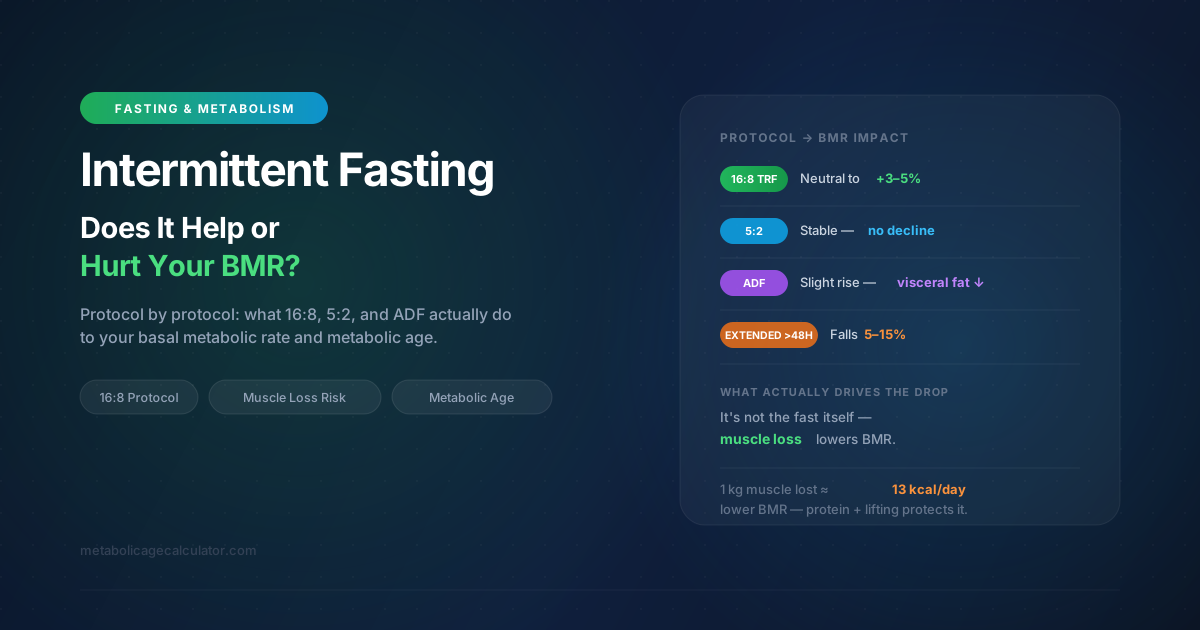
Intermittent fasting and metabolic age are directly linked: short fasting windows preserve or modestly raise Basal Metabolic Rate (BMR), while extended or poorly structured fasting risks lowering BMR through muscle loss.
The relationship depends on 3 variables: fasting duration, protein intake during eating windows, and resistance training frequency. Get all 3 right and intermittent fasting improves your metabolic age. Get them wrong and metabolic age rises.
Use the free metabolic age calculator to establish your BMR baseline before starting any fasting protocol. Track the number every 8–12 weeks to confirm fasting is moving your metabolic age in the right direction.
What Metabolic Age Measures and Why Fasting Affects It
Metabolic age compares your BMR to the average BMR for people your chronological age. A BMR above average for your age group produces a metabolic age below your real age. A BMR below average produces a metabolic age above your real age.
BMR is primarily determined by lean muscle mass. Each kilogram (2.2 lbs) of skeletal muscle burns roughly 13 kcal per day at rest. Lose muscle and BMR falls. Gain muscle and BMR rises.
Intermittent fasting affects metabolic age through 4 mechanisms:
- Norepinephrine release: Short fasts trigger norepinephrine spikes of 117–373% above baseline, which temporarily raises BMR and fat oxidation rate.
- Human Growth Hormone (HGH) elevation: Fasting raises HGH levels by up to 5-fold in men and 1.3-fold in women — preserving muscle mass during calorie restriction.
- Insulin reduction: Lower insulin during fasting shifts the body toward fat oxidation and improves insulin sensitivity, reducing visceral fat accumulation over time.
- Muscle mass risk: Fasting beyond 48 hours, or fasting with insufficient protein during eating windows, breaks down lean muscle — directly lowering BMR and raising metabolic age.
Intermittent Fasting Protocols and Their Effect on Metabolic Age
The table below compares the 5 main fasting approaches by BMR impact, muscle risk, and metabolic age outcome:
| IF Protocol | Fasting Window | BMR Impact | Muscle Risk | Metabolic Age Effect |
|---|---|---|---|---|
| 16:8 TRF | 16 hrs fast / 8 hrs eat | Neutral to +3–5% | Low (with adequate protein) | Neutral to mild improvement |
| 5:2 Diet | 2 days at 500–600 kcal | Neutral short-term | Low–Moderate | Neutral (requires protein targets) |
| ADF (Alternate-Day) | Every other day ≤ 25% calories | Slight rise in short fasts | Moderate (monitor muscle mass) | Mild improvement in some studies |
| Extended Fast (>48 hrs) | >48 continuous hours | Falls 5–15% temporarily | High without resistance training | Negative without muscle strategy |
| Calorie Restriction (non-IF) | Continuous 15–40% deficit | Falls 5–20% over weeks | High — adaptive thermogenesis risk | Worsens without muscle preservation |
How 16:8 Time-Restricted Feeding Affects BMR
To protect BMR on the 16:8 protocol, eat during an 8-hour window and fast for 16 hours. 16:8 TRF does not reduce BMR in most adults practising it correctly for 8–12 weeks.
A 2024 study published in Medsci found that intermittent fasting combined with adequate protein produced the same weight loss as continuous calorie restriction — 2.3 kg (5 lbs) over 8 weeks — without the adaptive thermogenesis that continuous restriction causes.
Norepinephrine rises during the fasting window increase fat oxidation. The net effect on metabolic age is neutral to mildly positive within 12 weeks for most adults. Read the BMR vs RMR guide to understand why your scale may be measuring RMR rather than true BMR during this period.
How 5:2 Fasting Affects BMR Compared to Daily Restriction
The 5:2 protocol restricts calories to 500–600 kcal on 2 days per week and allows normal eating on the other 5. BMR stays stable on 5:2 because the fasting days are short enough to prevent adaptive thermogenesis.
A 2022 review found that 5:2 fasting produced 3–8% body weight reduction over 8–12 weeks — matching calorie-restriction diets. The key difference: 5:2 preserves muscle mass better than continuous restriction because the 5 unrestricted days maintain anabolic signalling through mTOR pathways.
The muscle-preservation advantage disappears if protein intake on normal eating days falls below 1.2 g per kg (0.55 g per lb) of bodyweight. Low protein on normal days allows the fasting days to net-negative your muscle balance.
How Alternate-Day Fasting Affects Metabolic Age Differently
Alternate-Day Fasting (ADF) restricts intake to 25% of normal calories every other day. A 2025 study in BMC Endocrine Disorders found ADF produced the largest visceral fat reductions of any IF protocol tested — a direct metabolic age benefit.
ADF also produced reductions in LDL cholesterol of 56.22 mg/dL and systolic blood pressure drops of 5.54 mmHg — both markers of improved metabolic health. Visceral fat reduction lowers metabolic age because visceral fat suppresses insulin sensitivity and BMR.
ADF carries a moderate muscle-loss risk on the fasting days unless resistance training continues and protein targets are maintained on eating days.
Intermittent Fasting and Metabolic Age: When Fasting Hurts BMR
Fasting hurts BMR when it causes muscle loss. Muscle loss from fasting occurs under 3 conditions:
- Fasting windows extend beyond 48 consecutive hours without adequate protein refeeding.
- Protein intake during eating windows falls below 1.2 g per kg (0.55 g per lb) of bodyweight per day.
- Resistance training stops during the fasting period, removing the anabolic signal that protects muscle.
Research from Freedom from Diabetes reports that during longer fasts, BMR falls 5–15% temporarily. This reduction is reversible once eating resumes. The permanent BMR damage comes not from the fast itself but from the muscle loss that accompanies poorly structured extended fasting.
The Difference Between Temporary BMR Dips and Permanent Metabolic Slowdown
A temporary BMR dip during a fast reverses within 24–48 hours of refeeding. Permanent metabolic slowdown requires actual loss of lean body mass. The distinction matters for metabolic age.
Continuous calorie restriction — eating 15–40% below TDEE (Total Daily Energy Expenditure) every day — causes adaptive thermogenesis, reducing BMR by 5–20% over weeks. This is the mechanism that makes standard dieting plateau-prone and drives metabolic age upward.
Intermittent fasting avoids adaptive thermogenesis because the non-fasting days restore full calorie intake and anabolic signalling. This is the primary metabolic advantage of IF over continuous restriction for metabolic age management.
How Fasting Without Resistance Training Raises Metabolic Age
Fasting without resistance training allows sarcopenia — age-related muscle loss — to accelerate. Adults who fast without training lose 60% more muscle mass compared to those combining fasting with 3 sessions of resistance training per week.
Each 1 kg (2.2 lbs) of lost muscle reduces BMR by approximately 13 kcal per day. A 5 kg (11 lbs) muscle loss over 6 months reduces BMR by 65 kcal per day. Over a year, that equates to a BMR drop of roughly 25,000 kcal annually — equivalent to raising metabolic age by 3–5 years.
How to Use Intermittent Fasting to Lower Your Metabolic Age
To lower metabolic age with intermittent fasting, combine the correct protocol with 3 non-negotiable habits:
- Choose 16:8 or 5:2 as your entry protocol. Both carry the lowest muscle-loss risk. Start with 16:8 — fast from 8pm to 12pm the following day, eat normally from 12pm to 8pm.
- Hit 1.6–2.2 g of protein per kg (0.73–1.0 g per lb) of bodyweight daily within your eating window. High-protein foods: chicken breast (31 g per 100 g), eggs (13 g per 2 eggs), Greek yoghurt (17 g per 200 g), whey protein (25 g per scoop), lentils (18 g per 200 g cooked).
- Train with resistance 3 times per week. Progressive overload — increasing weight or reps every 2 weeks — maintains the anabolic signal that preserves muscle during fasting windows.
- Recheck your metabolic age every 8–12 weeks. BMR changes from IF take 8–12 weeks to register meaningfully on a metabolic age calculator. Monthly checks create noise, not signal.
- Sleep 7–9 hours per night. Sleep deprivation raises cortisol, which breaks down muscle and reduces BMR. Poor sleep cancels the metabolic benefits of intermittent fasting.
The complete strategy for improving metabolic age — including diet, training, sleep, and stress protocols — is covered in the lower your metabolic age guide.
Intermittent Fasting, Metabolic Age, and Metabolic Syndrome
Intermittent fasting reduces 4 of the 5 markers of metabolic syndrome: excess waist circumference, high triglycerides, high blood pressure, and elevated fasting glucose. HDL cholesterol shows minimal change with IF.
A 2024 meta-analysis of 11 randomised controlled trials found IF produced an average weight reduction of 3.59 kg (7.9 lbs) and a BMI drop of 1.39 kg/m². These changes directly lower metabolic age by reducing excess fat mass relative to lean mass.
How Insulin Sensitivity Changes During Fasting Affect Metabolic Age
Reduced insulin during fasting periods improves insulin sensitivity — the ability of muscle cells to absorb glucose efficiently. Higher insulin sensitivity allows muscle to maintain its metabolic activity, which protects BMR from declining with age.
Visceral fat — fat stored around the organs — suppresses insulin sensitivity and accelerates metabolic aging. ADF produced the only significant visceral fat reductions in the 12-month Vanvitelli University trial, making ADF the superior protocol for reducing metabolic syndrome markers.
What Autophagy During Fasting Does for Metabolic Health
Autophagy — the cellular cleanup process activated by AMPK during fasting — removes damaged mitochondria and proteins. Active autophagy improves mitochondrial efficiency in muscle cells, allowing each kilogram of muscle to burn more calories at rest.
Autophagy activates meaningfully after 14–16 hours of fasting in most adults. The 16:8 and 18:6 TRF protocols both reach this threshold daily, making autophagy a consistent metabolic benefit of these approaches.
How Intermittent Fasting and Metabolic Age Interact Differently by Decade
Fasting affects metabolic age differently across the lifespan because muscle-loss risk, hormone levels, and baseline BMR all shift with age.
Adults in Their 20s and 30s: Fasting Carries Low Metabolic Age Risk
Adults aged 20–39 carry the lowest risk of BMR decline from fasting because HGH levels remain relatively high and muscle-recovery capacity is at its peak. 16:8 TRF and 5:2 both produce metabolic age improvements in this group within 12 weeks when combined with resistance training.
A 2024 NIH study on obese young women (mean age 21) found that even a 20-day fasting intervention showed a trend toward metabolic age reduction in the ADF group — though full significance required longer duration.
Adults in Their 40s, 50s, and 60s: Protein and Training Become Non-Negotiable
Adults over 40 lose muscle mass at 1–2% per year due to sarcopenia. Fasting without protein targets and resistance training accelerates this loss, raising metabolic age rapidly.
Adults over 50 should target a minimum of 1.6 g of protein per kg (0.73 g per lb) of bodyweight on fasting and non-fasting days alike. Spreading protein across 3–4 meals of 30–40 g each maximises muscle protein synthesis during the eating window.
Fasting protocols for adults over 60 should prioritise 16:8 over ADF. ADF carries higher muscle-loss risk in older adults because the 24-hour fasting days suppress anabolic signalling for longer periods than the ageing body recovers from efficiently.
Frequently Asked Questions
Does intermittent fasting lower metabolic age?
Yes, with the right protocol and protein intake. 16:8 TRF and 5:2 fasting maintain or modestly improve metabolic age by preserving muscle mass and improving insulin sensitivity. ADF produces the largest visceral fat reductions of the 3 protocols, which further improves metabolic age over 12+ weeks.
Does fasting slow your metabolism permanently?
No, not if fasting is structured correctly. Short fasting windows (14–16 hours) raise norepinephrine and temporarily increase BMR. Permanent metabolic slowdown requires actual muscle loss, which fasting causes only when protein intake is inadequate or resistance training stops.
How long does intermittent fasting take to improve metabolic age?
8–12 weeks of consistent IF with resistance training and adequate protein produces measurable BMR changes. Recheck your metabolic age calculator results every 8 weeks to confirm progress.
Which intermittent fasting protocol is best for lowering metabolic age?
16:8 TRF for most adults; ADF for those with metabolic syndrome or high visceral fat. 16:8 carries the lowest muscle-loss risk and fits most adult lifestyles. ADF produces superior visceral fat reduction but requires stricter protein management on fasting days.
Can intermittent fasting raise metabolic age?
Yes, if fasting causes muscle loss. Extended fasts above 48 hours without protein refeeding, or any IF protocol without resistance training, reduces lean body mass. Each 1 kg (2.2 lbs) of muscle lost reduces BMR by 13 kcal per day — directly raising metabolic age.
Calculate Your Metabolic Age Before and After Fasting
Intermittent fasting and metabolic age move together predictably: protect your muscle mass during fasting windows and metabolic age improves. Lose muscle and metabolic age rises. The protocol matters — 16:8 TRF is the lowest-risk starting point for most adults, with ADF reserved for those targeting visceral fat or metabolic syndrome markers.
Get your BMR baseline now with the free metabolic age calculator. Enter your age, height, weight, and activity level and receive your metabolic age instantly — no email, no sign-up. Retest every 8–12 weeks as you implement fasting to confirm your BMR is moving in the right direction.