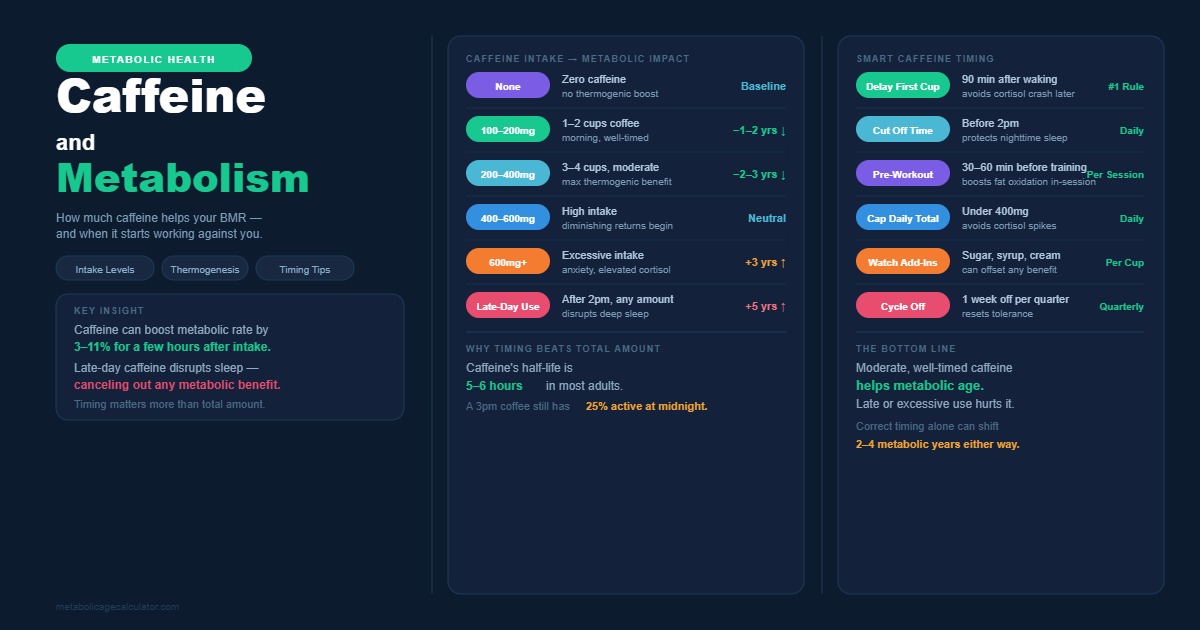
Caffeine and metabolism share a direct, measurable link. Coffee raises your resting metabolic rate (RMR) by 3% to 11% for up to 3 hours after you drink it. That boost comes from caffeine's stimulant effect on your nervous system, not from any hidden fat-burning trick. This guide breaks down the exact mechanism, the real numbers behind caffeine and metabolism research in 2026, and how to use coffee timing to your advantage. You will also find a quick-reference table, 5 frequently asked questions, and links to tools that measure your own metabolic numbers.
Does Caffeine Really Increase Your Metabolic Rate?
Yes, caffeine increases your metabolic rate through a documented physiological process. Caffeine blocks adenosine receptors in your brain and body, which triggers a release of epinephrine and norepinephrine. These 2 hormones speed up your heart rate, raise your body temperature, and increase the number of calories you burn at rest. A 1980 clinical trial published in the American Journal of Clinical Nutrition measured this effect directly. Subjects who took 8 mg of caffeine per kilogram of body weight, about 3.6 mg per pound, showed a significant rise in metabolic rate within 3 hours. Health organizations including the American Medical Association confirm that moderate caffeine intake raises metabolic rate and can improve workout output. The effect is real, but it is modest compared to strength training, protein intake, and sleep quality, which remain the 3 biggest levers for long-term metabolic health. Coffee works best as a supporting habit layered on top of those 3 fundamentals rather than a standalone weight loss strategy.
How Caffeine Triggers Thermogenesis in Your Body
Caffeine and metabolism connect through a process called thermogenesis, the production of heat from calorie burning. Your body converts stored energy into heat faster once caffeine enters your bloodstream. This process accounts for a meaningful share of your total daily energy expenditure, alongside your basal metabolic rate and physical activity.
What Happens Inside Your Cells After Coffee
To understand thermogenesis, you need to track caffeine's path after your first sip. Caffeine reaches your bloodstream within 15 to 45 minutes and crosses into your brain and muscle tissue. Once there, it blocks adenosine, the neurotransmitter that normally slows down nerve activity. Blocking adenosine is the single trigger that starts the entire metabolic chain reaction. Your central nervous system responds by increasing neuron firing, which raises alertness and prepares your body for higher energy output.
The Role of Epinephrine and Norepinephrine
Epinephrine and norepinephrine drive the calorie-burning effect you feel after coffee. These 2 catecholamines signal your fat cells to release fatty acids into your bloodstream, a process called lipolysis. Your muscles then use those fatty acids as fuel, which raises your total energy expenditure. Blood tests taken after caffeine intake consistently show elevated free fatty acid levels, confirming that this hormonal pathway drives real, measurable change rather than a placebo response.
How Much Does Coffee Raise Metabolic Rate, and How Long Does It Last
Multiple peer-reviewed studies confirm coffee raises resting metabolic rate by 3% to 11%, with some trials reporting increases as high as 20%. The effect peaks around 60 to 90 minutes after intake and fades within 3 hours. Henry Ford Health researchers found that participants who consumed twice the caffeine of a comparison group saw 22% more reduction in body weight and 28% more reduction in body fat over the course of a study period.
Your body weight also changes the size of the effect. Studies show leaner individuals with a lower body mass index (BMI) experience a stronger metabolic response than individuals with a higher BMI. Caffeine's fat-mobilizing signal has less stored fat to work against in leaner bodies. Age, sex, and habitual caffeine intake also shift the numbers, so 2 people drinking the same 12-ounce (355 ml) cup can see different results.
What Other Compounds in Coffee Influence Your Metabolism
Caffeine is the primary driver, but coffee contains several other biologically active compounds that support metabolic effects. Theobromine, the main stimulant in cocoa, appears in smaller amounts in coffee and adds a mild additional thermogenic push. Theophylline, another stimulant shared by cocoa and coffee, relaxes airway muscles and modestly raises heart rate. Chlorogenic acid, one of the most studied compounds in coffee, slows carbohydrate absorption in your gut and may support more stable blood sugar levels after meals. Together, these 3 compounds explain why whole coffee often outperforms isolated caffeine supplements in metabolic studies. High-quality, well-sourced coffee beans also reduce your exposure to mold-related contaminants that can independently affect gut health and hormone balance.
How to Time Your Coffee for Maximum Metabolic Effect
To time your coffee for maximum metabolic effect, drink it 30 to 45 minutes before physical activity. This window lets caffeine reach peak blood concentration right as you start moving, which stacks the thermogenic effect on top of exercise-driven calorie burn. Avoid caffeine within 6 hours, about 360 minutes, of bedtime, since disrupted sleep raises cortisol and can offset any metabolic gain from your morning cup. Split larger doses into 2 smaller servings, such as 100 mg in the morning and 100 mg in early afternoon, rather than 1 large 400 mg dose, to reduce jitteriness while sustaining the metabolic effect longer. Pairing your coffee with a high-protein breakfast, rather than drinking it on an empty stomach, reduces gut irritation without blunting the thermogenic response.
Why Your CYP1A2 Gene Changes Your Caffeine and Metabolism Response
The CYP1A2 gene, short for cytochrome P450 1A2, controls how fast your liver breaks down caffeine. This single enzyme explains why caffeine and metabolism outcomes vary so widely between individuals, and it accounts for most of the difference between people who feel an energy boost for hours and people who barely notice their coffee. Genetic testing panels now include CYP1A2 variants, giving you a way to confirm your metabolizer type rather than guessing from symptoms alone.
Fast Metabolizers
Fast metabolizers clear caffeine from their bloodstream quickly, typically within 2 to 4 hours. These individuals process caffeine efficiently and often show a stronger, shorter-lived spike in metabolic rate without a lasting rise in blood pressure. Fast metabolizers can typically consume up to the standard 400 mg daily limit without significant sleep disruption.
Slow Metabolizers
Slow metabolizers carry a variant allele that roughly 50% of the population possesses. Slow metabolizers process caffeine at a much lower rate, which lets it build up in the bloodstream after multiple cups. This group faces a higher risk of hypertension and often reports jitteriness, anxiety, or disrupted sleep from the same dose that a fast metabolizer tolerates easily. Slow metabolizers benefit most from limiting intake to a single morning cup and avoiding afternoon caffeine entirely.
Does Caffeine Tolerance Cancel Out the Metabolic Boost?
No, caffeine tolerance reduces the metabolic boost but does not eliminate it completely. Regular daily consumption trains your adenosine receptors to respond less strongly to caffeine, which shrinks the thermogenic effect over 1 to 2 weeks of consistent intake. Cycling your intake, such as reducing consumption for 3 to 5 days every few months, restores sensitivity and brings back a stronger metabolic response. Rotating between regular coffee and lower-caffeine options like green tea also helps maintain receptor sensitivity over time. Tracking your daily caffeine total for 1 to 2 weeks reveals patterns you might otherwise miss, such as hidden caffeine in chocolate, soda, or pre-workout supplements.
Coffee, Exercise, and Fat Oxidation
Coffee improves exercise performance and increases the proportion of fat your body burns as fuel during moderate-intensity activity. A dose of 3 to 6 milligrams per kilogram of body weight, roughly 1.4 to 2.7 mg per pound, enhances muscular endurance, movement speed, and muscular strength during training sessions. Athletes who consume coffee before workouts report lower perceived effort, which allows longer training sessions and greater total calorie expenditure. This combination of enhanced fat oxidation and extended training capacity is why caffeine and metabolism research consistently points toward pre-workout coffee as one of the most reliable, low-cost performance tools available. Non-coffee caffeine sources, including chewing gum, energy gels, and sports drinks, produce similar performance benefits for athletes who dislike the taste of coffee before training.
Tracking your baseline energy expenditure gives these numbers real context. Checking your personal metabolic age before and after adding a caffeine routine shows whether the changes you feel translate into measurable metabolic shifts, rather than relying on how energized you feel alone.
Common Mistakes That Cancel Out Caffeine's Metabolic Boost
Several everyday habits quietly cancel out the metabolic benefits described above. Adding more than 1 tablespoon of sugar or syrup to your coffee adds 50 or more empty calories, which outweighs any calorie burn from the caffeine itself. Drinking coffee too late in the day disrupts sleep, and poor sleep raises cortisol levels that promote fat storage rather than fat loss. Relying on caffeine as a substitute for adequate food intake triggers fatigue and muscle loss instead of genuine energy gains. Consuming caffeine at doses above 400 mg per day, roughly 4 standard cups, increases side effects without adding further metabolic benefit, since the thermogenic response plateaus well before that threshold.
Caffeine and Metabolism During Postpartum Recovery
Caffeine and metabolism interact differently during postpartum recovery because hormone levels, sleep patterns, and calorie needs all shift after childbirth. Medical guidelines consider up to 200 mg of caffeine per day, about 2 cups of coffee, safe for most breastfeeding parents. Caffeine passes into breast milk in small amounts, typically under 1% of the maternal dose, so moderate intake rarely affects a healthy full-term infant. Postpartum metabolism already runs through significant hormonal changes, so pairing moderate caffeine intake with adequate sleep and protein intake supports metabolic recovery better than caffeine alone. New parents managing interrupted sleep should treat caffeine as a short-term alertness tool rather than a metabolic fix, since chronic sleep debt outweighs any thermogenic gain from coffee. Spreading intake across the day, rather than consuming a large dose right before nursing, further reduces the small amount that reaches breast milk.
Regular Coffee vs Decaf: Which One Affects Metabolism More?
Regular coffee affects metabolism more than decaf because decaffeination removes 97% or more of the caffeine content. Decaf coffee still contains chlorogenic acid and other polyphenols that offer antioxidant benefits, but it produces little to no measurable thermogenic effect. A standard 8-ounce, 237 ml, cup of decaf contains roughly 2 to 5 mg of caffeine, compared to 95 mg in the same size cup of regular coffee. If your goal centers on caffeine and metabolism benefits specifically, regular coffee delivers the stimulant dose that decaf cannot match. Decaf remains a reasonable evening choice for people who want the ritual of coffee without the sleep disruption that regular caffeine causes.
Building your own caffeine schedule works best alongside a full picture of your daily calorie burn. Our free macro calculator lets you set protein, carb, and fat targets that match the extra energy expenditure caffeine provides.
Quick-Reference Table: Caffeine Sources, Timing, and Metabolic Impact
|
Task |
Timing |
Method |
Difficulty |
|
Morning metabolic boost |
Within 1 hour of waking |
1 cup (8 fl oz / 237 ml) brewed coffee, 95 mg caffeine |
Easy |
|
Pre-workout fat oxidation |
30-45 minutes before exercise |
3-6 mg/kg body weight caffeine |
Moderate |
|
Afternoon split dose |
Early afternoon, before 2 PM |
100 mg caffeine, second serving of the day |
Easy |
|
Tolerance reset |
Every 8-12 weeks |
Reduce intake by 50% for 3-5 days |
Moderate |
|
Sleep protection |
Stop 6 hours before bed |
Switch to decaf or herbal tea |
Easy |
Frequently Asked Questions
Does coffee really boost metabolism, or is it a myth?
Yes, coffee genuinely boosts metabolism. Clinical research confirms a 3% to 11% rise in resting metabolic rate within 3 hours of intake, driven by caffeine's stimulation of your nervous system.
How many cups of coffee do you need to see a metabolic effect?
1 standard 8-ounce (237 ml) cup, containing about 95 mg of caffeine, produces a measurable metabolic effect in most healthy adults within 15 to 45 minutes.
Does caffeine tolerance stop coffee from working for weight loss?
No, tolerance reduces the effect but does not stop it. Cycling your intake every 8 to 12 weeks restores a stronger response and prevents the boost from disappearing entirely.
Is caffeine safe for metabolism if you have a slow CYP1A2 gene variant?
Slow metabolizers should limit intake to under 200 mg per day and monitor blood pressure, since caffeine builds up more in their system and raises hypertension risk.
Does decaf coffee offer any metabolic benefit at all?
No, decaf offers minimal metabolic benefit. It contains only 2 to 5 mg of caffeine per 8-ounce (237 ml) cup, far below the thermogenic threshold most studies use.
Conclusion
Caffeine and metabolism connect through a clear, well-documented chain: adenosine blocking, catecholamine release, and increased thermogenesis. A single cup of coffee raises your resting metabolic rate for up to 3 hours, and smart timing around workouts and sleep extends those benefits without the downsides of overuse. Your genetics, body composition, and daily habits all shape how strongly you respond, which makes personal tracking more useful than generic advice. See how your own numbers stack up by checking how BMR is calculated and running your data through the free tools at metabolicagecalculator.com.