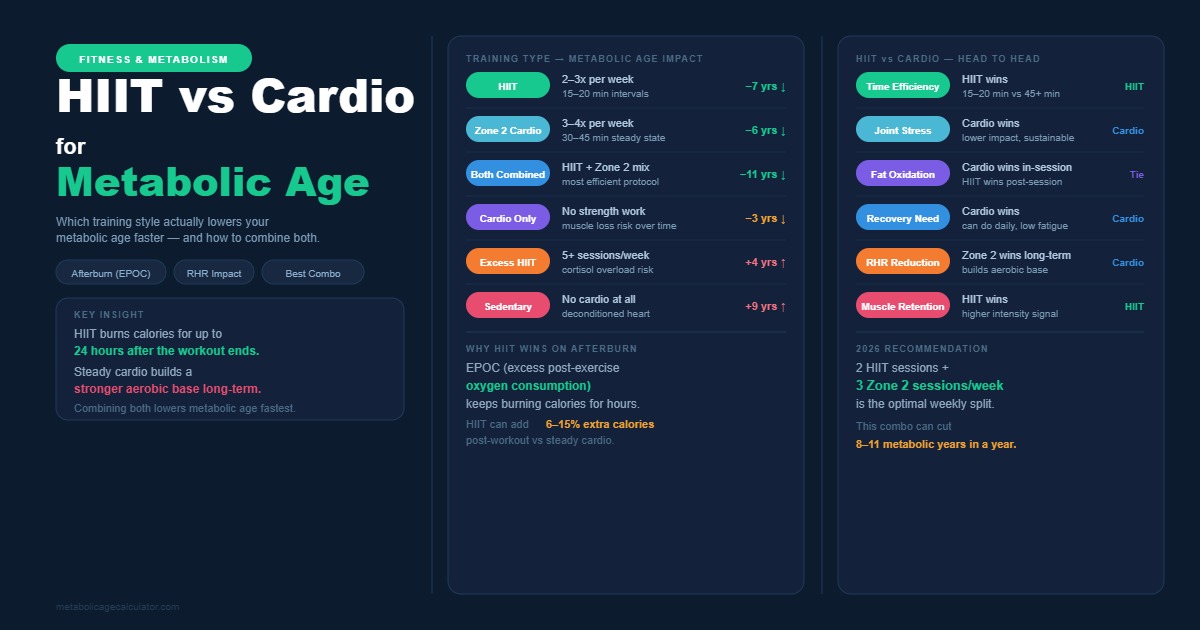
HIIT lowers metabolic age faster than steady-state cardio for most adults under 45 years old. Interval training raises your resting metabolism for 14 to 24 hours after a single session, while steady-state cardio delivers slower but more sustainable gains through better mitochondrial function. You get faster short-term results from HIIT and steadier long-term results from steady-state cardio. The fastest 2026 approach blends both methods based on your age, joint health, and weekly schedule. This guide breaks down the exact mechanisms behind each method, names the best option for your age group, and gives you a weekly schedule to follow starting today.
Which Workout Lowers Metabolic Age Faster: HIIT or Steady-State Cardio?
High-Intensity Interval Training (HIIT) lowers metabolic age faster than steady-state cardio within the first 8 to 12 weeks of consistent training. HIIT triggers Excess Post-Exercise Oxygen Consumption (EPOC), which keeps your resting metabolism elevated for 14 to 24 hours after one 20-minute session. Steady-state cardio, also called moderate-intensity continuous training (MICT), produces a smaller afterburn but builds mitochondrial density more efficiently across 12 to 16 weeks.
Three factors decide which method lowers your metabolic age faster: your current fitness level, your joint health, and your weekly time budget. Beginners above 200 pounds (91 kg) often progress faster and stay injury-free with steady-state cardio first. Trained adults under 45 years old typically see metabolic age drop 2 to 4 years faster with HIIT.
A 2024 systematic review analyzing 508 adults aged 18 to 60 years found that HIIT produced the fastest fat loss in the youngest group. Middle-aged adults between 31 and 40 years showed similar results from both methods, though researchers noted higher adherence with steady-state cardio. Adults between 41 and 60 years achieved more consistent fat loss and muscle preservation through steady-state cardio across the full study period. Time available per week also matters: a 20-minute HIIT session delivers a similar calorie-burn effect to 45 minutes of steady-state cardio.
What Is Metabolic Age and Why Does Exercise Type Matter?
Metabolic age compares your Basal Metabolic Rate (BMR) to the average BMR of your chronological age group. A lower metabolic age means your body burns calories at rest like someone younger than you. Exercise type changes this score because muscle tissue, mitochondrial count, and resting heart rate each respond differently to interval training versus continuous training.
Three variables drive your metabolic age result: lean muscle mass, resting heart rate, and daily activity level. Muscle burns 3 times more calories per hour at rest than fat tissue. Your resting heart rate drops by 1 to 3 beats per minute after 8 weeks of steady cardio, signaling improved cardiac efficiency. You raise your BMR and lower your metabolic age by building muscle, training your heart, and staying consistent for 90 days or longer.
Metabolic age differs from Body Mass Index (BMI) because BMI only measures weight relative to height. A muscular adult weighing 180 pounds (82 kg) and a sedentary adult at the same weight can share an identical BMI score. Metabolic age separates these 2 people clearly, because the muscular adult carries a higher resting calorie burn. Exercise type shifts your metabolic age faster than diet alone in most cases, since training changes muscle mass, mitochondrial count, and cardiac output at the same time.
How Does HIIT Lower Metabolic Age?
HIIT lowers metabolic age through 2 primary mechanisms: the EPOC afterburn effect and rapid muscle-fiber recruitment. A single 20-minute HIIT session burns 250 to 450 extra calories over the following 24 hours through EPOC alone. This afterburn effect does not occur at the same scale during steady-state cardio, because your heart rate never spikes into the 80 to 95% max heart rate zone that triggers it.
HIIT also recruits fast-twitch muscle fibers more aggressively than steady-state cardio. Fast-twitch fibers burn more calories per contraction than slow-twitch fibers, which raises your total energy expenditure during and after the workout. Three muscle groups activate hardest during standard HIIT circuits: quadriceps, glutes, and calves. Repeated recruitment of these muscle groups over 8 to 12 weeks builds the lean tissue that keeps your resting metabolism elevated long after the afterburn window closes.
How to Structure a HIIT Session for Metabolic Age
To structure a HIIT session for metabolic age improvement, alternate 30 seconds of maximum effort with 90 seconds of active recovery for 8 to 10 rounds. Warm up for 5 minutes before the first interval and cool down for 5 minutes after the last one. Perform this protocol 2 to 3 times per week, never on consecutive days, so your muscles recover fully. Three HIIT formats work well for beginners: Tabata intervals, sprint-recovery cycles, and bodyweight circuits built from burpees, squat jumps, and mountain climbers.
The EPOC Afterburn Effect Explained
EPOC (Excess Post-Exercise Oxygen Consumption) measures the extra oxygen your body consumes after intense exercise to restore itself to a resting state. Your body repays an oxygen debt, replenishes ATP stores, and clears lactate for 14 to 24 hours after a hard HIIT session. This process raises your resting metabolism, which directly lowers the metabolic age figure you get from a body fat percentage tool alongside your BMR.
How Does Steady-State Cardio Lower Metabolic Age?
Steady-state cardio lowers metabolic age by building mitochondrial density and improving cardiac efficiency across 12 to 16 weeks. Zone 2 training, performed at 60 to 70% of your max heart rate, increases the number of mitochondria inside your muscle cells. More mitochondria mean your cells convert oxygen into energy more efficiently, which raises your resting calorie burn over months rather than hours.
How to Build Zone 2 Cardio Into Your Week
To build Zone 2 cardio into your week, schedule 3 to 5 sessions of 30 to 45 minutes at a conversational pace. Calculate your Zone 2 range by subtracting your age from 220, then multiplying the result by 0.6 and 0.7. Walk, cycle, or swim inside that heart rate range for the full session length. Three reliable Zone 2 activities suit most adults: brisk walking at 3 to 4 miles per hour (4.8 to 6.4 km/h), stationary cycling, and lap swimming.
Mitochondrial Density and Long-Term Metabolic Health
Mitochondrial density rises measurably after 8 to 12 weeks of consistent Zone 2 training. Higher mitochondrial density improves your VO2 Max, the measurement of how much oxygen your body uses during exercise. A higher VO2 Max correlates directly with a lower metabolic age, because your cardiovascular system supports calorie burning at rest more efficiently.
Sedentary aging adults who add steady-state cardio for 6 weeks show measurable gains in cardiovascular reserve without added cardiac strain. Published exercise research confirms this pattern in men over 60 years old. This makes steady-state cardio the safer entry point for adults returning to exercise after 5 years or more of inactivity. Three low-impact entry activities work well for this group: recumbent cycling, water walking, and treadmill walking at an incline of 3 to 5%.
HIIT vs Steady-State Cardio: Quick Comparison Table
The table below compares HIIT and steady-state cardio across 5 factors that shape your metabolic age result. Use it to match your training choice to your recovery capacity and available time, then confirm progress with a quarterly metabolic age recheck.
|
Factor |
HIIT |
Steady-State Cardio |
|
Speed of metabolic age drop |
Faster, 8-12 weeks |
Slower, 12-16 weeks |
|
Primary mechanism |
EPOC afterburn effect |
Mitochondrial density growth |
|
Session length |
15-20 minutes |
30-45 minutes |
|
Joint impact |
Higher |
Lower |
|
Best age group |
18-40 years |
41 years and older |
Which Option Fits Your Age Group and Fitness Level?
Your age group changes which method lowers metabolic age faster with the least injury risk. Adults aged 18 to 30 years respond fastest to HIIT, a pattern confirmed by a systematic review covering 508 participants aged 18 to 60. Adults aged 41 to 60 years see more sustainable metabolic age improvement from steady-state cardio, because adherence rates stay higher across 12 months of training.
Hormonal shifts explain part of this age-based difference. Testosterone declines roughly 1% per year in men after age 30, which slows the muscle-building response to HIIT. Estrogen decline between ages 35 and 45 in women slows fat metabolism by up to 15%, which makes consistent steady-state cardio a reliable complement to strength work. Both hormonal changes make combined training more valuable after age 40 than either method alone.
Best Choice for Adults Under 40
Adults under 40 years old lower metabolic age fastest with 2 to 3 HIIT sessions weekly, paired with 2 strength sessions. HIIT produces the largest metabolic age drop in this age group within 8 weeks. Add 1 steady-state session per week to support recovery and protect your joints.
Best Choice for Adults Over 50
Adults over 50 years old lower metabolic age most safely with steady-state cardio as the primary method. Schedule 4 to 5 Zone 2 sessions weekly, each lasting 30 to 40 minutes. Add 1 modified HIIT session every 2 weeks once your cardiovascular base improves, using longer recovery periods of 2 to 3 minutes between efforts.
How to Combine HIIT and Cardio for Fastest Metabolic Age Results
To combine HIIT and cardio for fastest metabolic age results, alternate 2 HIIT sessions and 3 steady-state sessions across your training week. Schedule HIIT on Monday and Thursday, then place steady-state cardio on Tuesday, Saturday, and Sunday. Rest completely 1 day per week to allow full muscle and cardiovascular recovery. Add 2 strength training sessions on Wednesday and Friday to support the muscle mass that keeps your resting BMR elevated between cardio sessions.
Track your progress every 90 days using a calorie deficit calculator alongside your metabolic age result to confirm your energy balance still supports fat loss.
How Does Nutrition Timing Affect Metabolic Age Results?
Nutrition timing affects metabolic age results by controlling how much muscle you retain during training. Eating 20 to 40 grams of protein within 2 hours after HIIT or steady-state cardio supports muscle repair and preserves your resting BMR. Skipping post-workout protein slows recovery and blunts the muscle-building response to both training methods.
Three protein sources work well after training sessions: grilled chicken breast, Greek yogurt, and whey protein shakes. Pair your post-workout meal with 30 to 60 grams of carbohydrates after HIIT to replace glycogen used during high-intensity intervals. Steady-state cardio uses less stored glycogen, so a smaller carbohydrate portion of 15 to 30 grams works well after those sessions.
Common Mistakes That Slow Metabolic Age Improvement
Three common mistakes slow metabolic age improvement regardless of which cardio method you choose: skipping strength training, under-eating protein, and training at the same intensity every session. Skipping strength training limits the muscle mass gains that raise your resting BMR. Under-eating protein below 1.6 grams per kilogram of bodyweight slows muscle repair after both HIIT and steady-state sessions. Training at the same intensity every day prevents the adaptation that lowers metabolic age over time.
Pair your cardio plan with a macro calculator tool to confirm your protein target supports muscle retention during a calorie deficit.
Poor sleep ranks as a fourth mistake that undermines both training methods equally. Sleep deprivation raises cortisol, a stress hormone that breaks down muscle tissue and promotes fat storage around your midsection. Five nights of 6-hour sleep reduce insulin sensitivity by roughly 25%, which slows recovery from both HIIT and steady-state sessions. Target 7 to 9 hours of sleep nightly to protect the muscle gains your training produces and to keep your metabolic age moving in the right direction.
Frequently Asked Questions: HIIT vs Cardio Metabolic Age
Does HIIT lower metabolic age faster than cardio?
Yes. HIIT lowers metabolic age faster than steady-state cardio in most adults under 45 years old, mainly through the EPOC afterburn effect that raises resting metabolism for 14 to 24 hours after each session.
Can steady-state cardio lower metabolic age without HIIT?
Yes. Steady-state cardio lowers metabolic age without HIIT by building mitochondrial density and improving cardiac efficiency over 12 to 16 weeks of consistent training.
How many HIIT sessions per week lower metabolic age?
Two to 3 HIIT sessions per week lower metabolic age most effectively. Space sessions with at least 1 rest day between them to allow muscle recovery.
Is HIIT safe for adults over 50?
Yes, with modification. Adults over 50 years old should use recovery periods of 2 to 3 minutes between efforts and build a cardiovascular base with steady-state cardio first.
How long does it take to lower metabolic age with exercise?
Most adults see a measurable metabolic age drop within 8 to 12 weeks of consistent HIIT or steady-state cardio, combined with adequate protein intake and 7 to 9 hours of sleep. Recheck your result every 90 days to confirm the trend continues in the right direction.
Your Next Step to a Lower Metabolic Age
Your fastest path to a lower metabolic age combines 2 HIIT sessions and 3 steady-state cardio sessions each week, backed by 1.6 to 2.2 grams of protein per kilogram of bodyweight. Recalculate your numbers every 90 days with the BMI calculator tool on Metabolic Age Calculator to confirm your training plan keeps working for your specific body.